Teyvat PaletteTeyvat colour cards
Scene library
GitHub
Gallery
The Rain's End in Green Shade
SumeruDayDeep greenDampBreath held

The Rain's End in Green Shade

Palette

Click a swatch to copy its HEX; hover for the OKLCH value.

Reconstructed gradient

The gradient distilled from the scene, unrolled left to right by stop; the authored angle is 180° (used by the hero and exports), while gallery cards share a uniform 135° sweep.

0%08262b22%446a7640%196f6858%619d6172%8d977f86%4ab3d7100%2a7839

Why it works

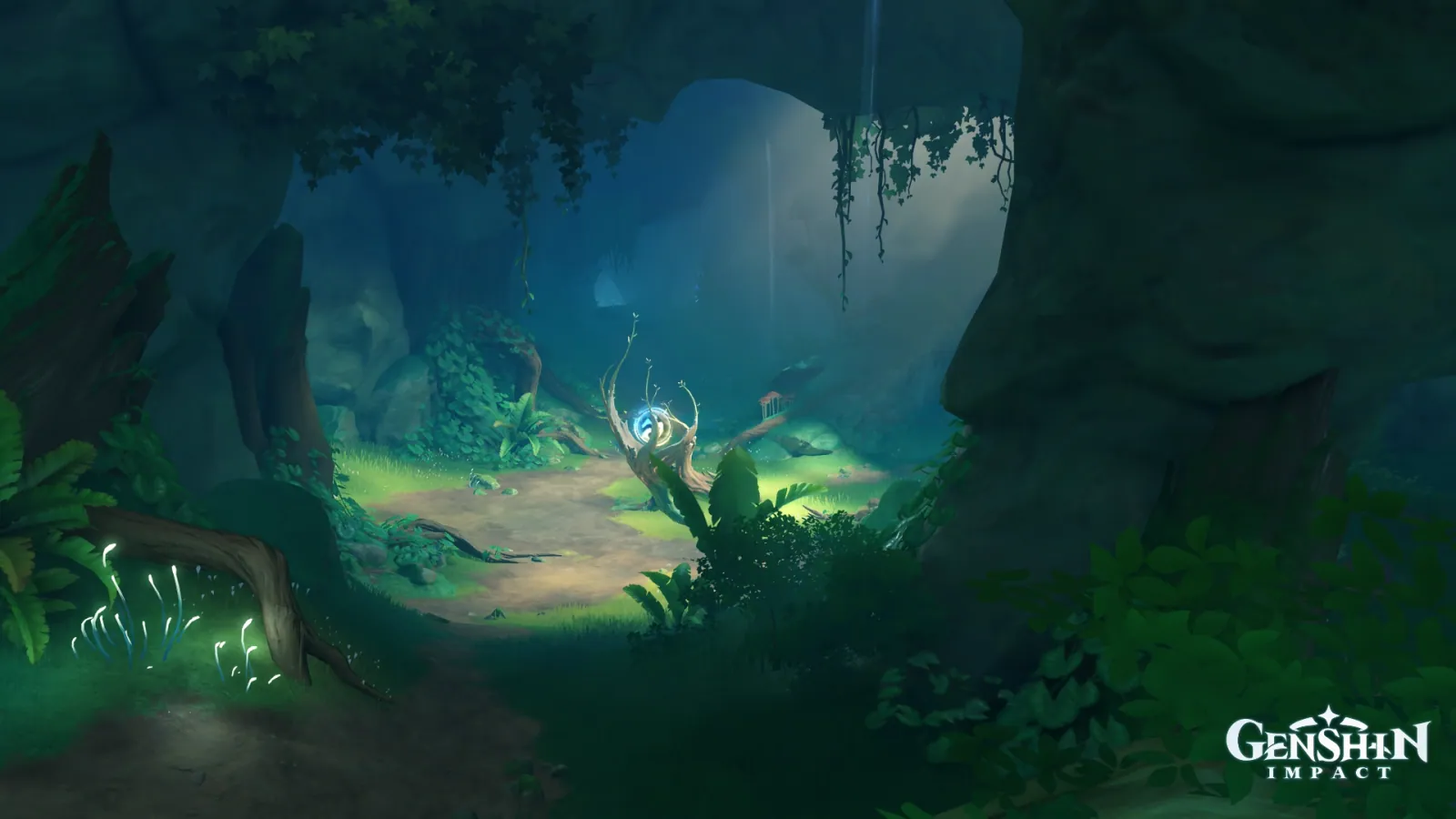
Crop the main light source entirely out of frame and the chroma ceiling loses nothing; what it loses is the top of the lightness axis. The Rain's End is the only one of these four with no visible main light: its brightest 4000 pixels all land on the sunlit patch of ground (L 0.83–0.84) and L p99 reaches only 0.72 — yet its ceiling of 0.156 sits in the same bracket as Liloupar's Cell under the Skylight, which keeps its skylight in frame (0.161), and Great Hall of Truths by Brazier Light, which keeps its fires (0.164), a spread of just 0.008. The ceiling answers to the lit surface, not to the light. If you don't want a piercing white in the picture but still want it to look lit, move the source out of frame and keep only a patch of lit ground: chroma is not discounted, and all you give up is the upper end of lightness.

01

The ceiling grows on the grass, not on the light

The lit grass on the clearing measures L 0.64 / chroma 0.108 / hue 144°, and its Cmax of 0.156 is the frame's ceiling. Of the 4000 most chromatic pixels, 3596 fall in 120°–150° at a mean of L 0.74 / chroma 0.128, centred at (0.42, 0.61) — that same patch of sun. The picture is not without glowing things: the clump of glowbulbs at lower left holds 531 of the brightest 4000 (L 0.89 / chroma 0.046), and the lamp-bead on the branch reads L 0.72 / 0.108 in its most saturated 3%. But the light that lights this clearing never appears once. When setting the chroma ceiling of a dark scene, the thing to measure is which surface the light lands on, not how bright the light is.

02

74.62% is cyan and blue, and it still reads as green forest

The census gives 165°–270° a 74.62% share (cyan 47.51% plus blue 27.11%); green holds only 16.90%. Sample the same vegetation at six levels of exposure: L 0.64 / chroma 0.108, 0.51 / 0.080, 0.49 / 0.078, 0.32 / 0.053, 0.25 / 0.048, 0.25 / 0.036 — chroma falls to a third, and it falls together with lightness, so what dims it is unlit material rather than air. "Green", then, is not this forest's colour; it is the name of the sixth of it that gets lit. To make dark vegetation read as green you don't need to raise the saturation of the whole mass: light one sixth, and the other five sixths can go all the way down to 0.036.

03

A dirt path with not one warm pixel

The path crossing the clearing reads as yellow earth; measured at three spots it is L 0.64 / chroma 0.030 / 128°, 0.66 / 0.036 / 126°, 0.67 / 0.040 / 110° — green, and at less than a third of the chroma of the lit grass beside it. The entire frame holds roughly 970 pixels in 330°–90° (0.11%), and even the most saturated 3% of those, 29 pixels, only reach chroma 0.068. A picture that convinces everyone it is a clear day cannot produce a single warm pixel: the sun is not in the frame, so "there is sun" is performed entirely by that patch of light and by this pale band sitting 0.13 above its neighbours. Elton Trench in Dimmed Daylight crowned a 145° yellow-green as gold against 54.58% of blue — that was a ranking in hue. Here even the ranking is unnecessary: once the source is cropped out, "warm" and "bright" are held by the same surface.

Take these colours with you

CSS variables, a Tailwind v4 theme or SVG — one click to copy into your project.

/* The Rain's End in Green Shade · The Rain's End in Green Shade — Teyvat Palette */
:root {
  --canopy-shadow: oklch(0.25 0.036 211); /* Canopy Shadow Blue #08262b */
  --gap-mist: oklch(0.5 0.047 220); /* Gap Mist Blue #446a76 */
  --misted-shrub: oklch(0.49 0.078 187); /* Misted Shrub #196f68 */
  --sunpatch-green: oklch(0.64 0.108 144); /* Sunpatch Green #619d61 */
  --path-pale: oklch(0.66 0.036 126); /* Path Pale #8d977f */
  --seelie-blue: oklch(0.72 0.108 224); /* Seelie Blue #4ab3d7 */
  --glowbulb-teal: oklch(0.51 0.124 147); /* Glowbulb Teal #2a7839 */
  --gradient-the-rains-end: linear-gradient(180deg, oklch(0.25 0.036 211) 0%, oklch(0.5 0.047 220) 22%, oklch(0.49 0.078 187) 40%, oklch(0.64 0.108 144) 58%, oklch(0.66 0.036 126) 72%, oklch(0.72 0.108 224) 86%, oklch(0.51 0.124 147) 100%);
}

A 1080×1350 PNG carrying the scene, its palette and every value — save it and post it as is.