Teyvat PaletteTeyvat colour cards
Scene library
GitHub
Gallery
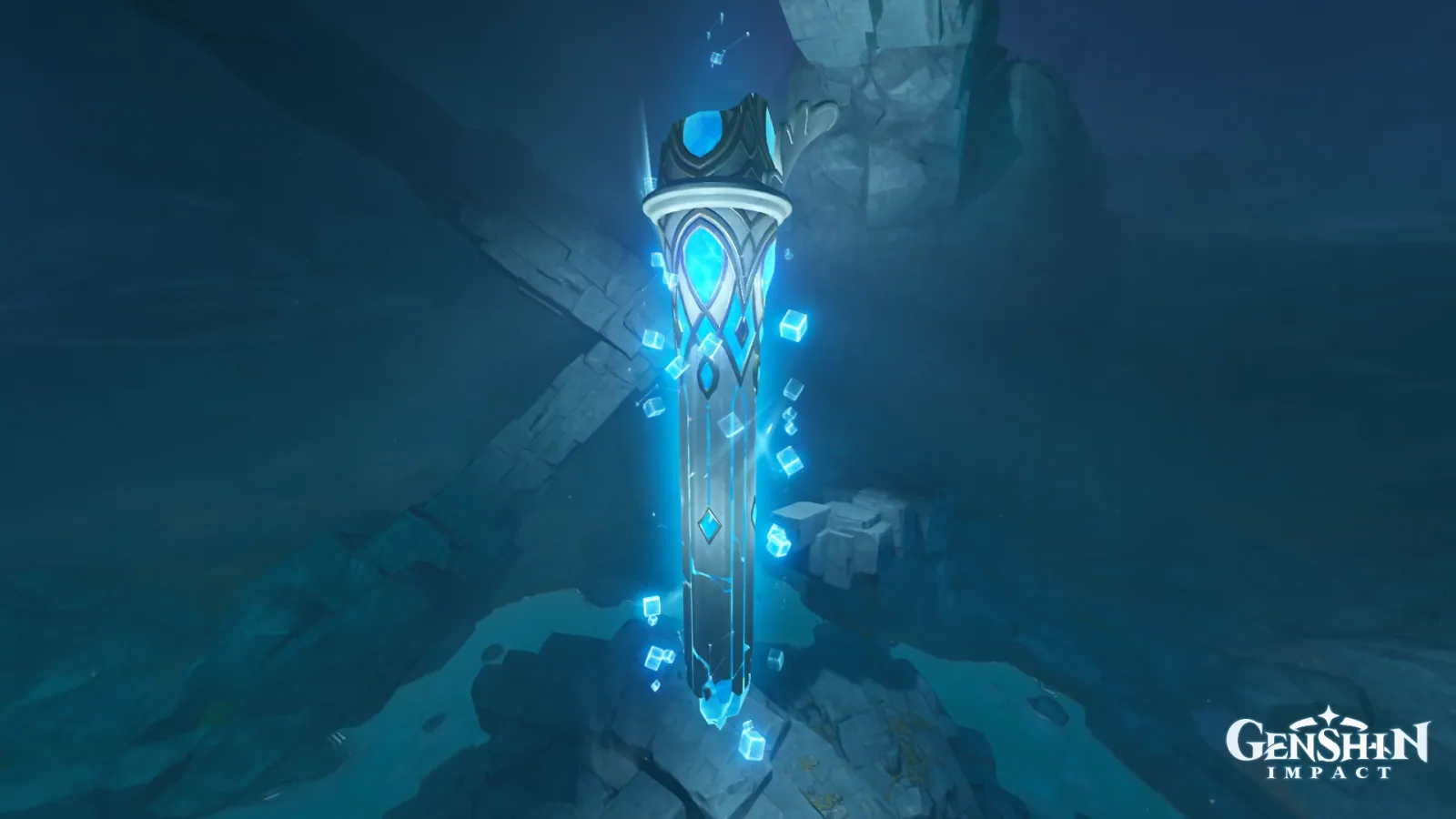
Spiritstone in a Lone Light
LiyueSecludedSuspendedCold-clear

Spiritstone in a Lone Light

Palette

Click a swatch to copy its HEX; hover for the OKLCH value.

Reconstructed gradient

The gradient distilled from the scene, unrolled left to right by stop; the authored angle is 180° (used by the hero and exports), while gallery cards share a uniform 135° sweep.

0%0d2f4125%72e7e850%4494b775%31647d100%0e4152

Why it works

Grey is not a colour but a balance: the difference two colour temperatures leave on one surface after cancelling out. This cavern has exactly one light, so it cannot produce a single grey pixel — 0.00% achromatic, and a 255°-wide window on the wheel (`270°–165°`) returns nothing matched. If you want a neutral surface, start by counting the lights in the picture.

01

255° of the wheel stands empty

99.99% of the frame's pixels are packed into the 105° between 165° and 270° — blue at 99.44% (mean 233°) plus cyan at 0.55% — and `r=0,0,1,1:270-165` returns nothing matched: not one pixel across a 255°-wide window. The 180° void in 〈Fane of Ashvattha, Moonpale〉 was the library's hardest absence claim; this one is 75° wider. The same census reads 0.00% achromatic: even the option of holding no hue does not exist. When a single coloured light enters a sealed space, the picture can neither emit a second hue nor find a second colour temperature to cancel against — those are one fact, not two.

02

Grey is the balance, and there is no balance here

The floor in 〈Adventurers' Guild Mondstadt at Lamplit Dusk〉, chroma 0.022 at 201°, was warm lamplight and night blue cancelling on one surface. The Spiritstone's cavern has no second light, so falloff can only trace its own line: the same rock wall reads L 0.29 / chroma 0.051 / 236° at the upper left, furthest from the stone, and L 0.48 / 0.068 / 232° at the upper right, nearest to it — lightness up 0.19, chroma up 0.017 with it, hue moved 4°. Falloff does not make grey; it only makes a darker version of the same colour. Placing a neutral surface in a single-light scene is not a mixing problem: with no mechanism in the frame that produces grey, that patch will read as a lie however you tune it.

03

Even the white cannot hand back its chroma

The 4000 brightest pixels all land in the x=0.4 column — the Spiritstone's shaft — reading, top to bottom, lightness 0.91 / 0.92 / 0.92 / 0.91 at chroma 0.080 / 0.087 / 0.088 / 0.088, which is higher than the frame's chroma median of 0.062. 〈Hiisi Island in the Last Light〉 said that to make something glow you should not compete for the brightest but for the one thing in the frame with no hue. That road is closed here, because in this picture holding no hue is not scarce — it is impossible. So the Spiritstone pays in hue distance instead: the 1,495 pixels of its core that fall in 165°–200° measure L 0.86 / chroma 0.106 / hue 196°, sitting 37° off the field's 233°. The only hue in the frame with a different position is the light source itself.

Take these colours with you

CSS variables, a Tailwind v4 theme or SVG — one click to copy into your project.

/* Spiritstone in a Lone Light · Spiritstone in a Lone Light — Teyvat Palette */
:root {
  --cavern-blue: oklch(0.38 0.065 233); /* Cavern Blue #17485f */
  --far-rock: oklch(0.29 0.051 236); /* Far Rock #0d2f41 */
  --near-rock: oklch(0.48 0.068 232); /* Near Rock #31647d */
  --pillar-blue: oklch(0.63 0.094 230); /* Pillar Blue #4494b7 */
  --core-cyan: oklch(0.86 0.106 196); /* Core Cyan #72e7e8 */
  --gradient-spiritstone: linear-gradient(180deg, oklch(0.29 0.051 236) 0%, oklch(0.86 0.106 196) 25%, oklch(0.63 0.094 230) 50%, oklch(0.48 0.068 232) 75%, oklch(0.35 0.059 225) 100%);
}

A 1080×1350 PNG carrying the scene, its palette and every value — save it and post it as is.