Teyvat PaletteTeyvat colour cards
Scene library
GitHub
Gallery
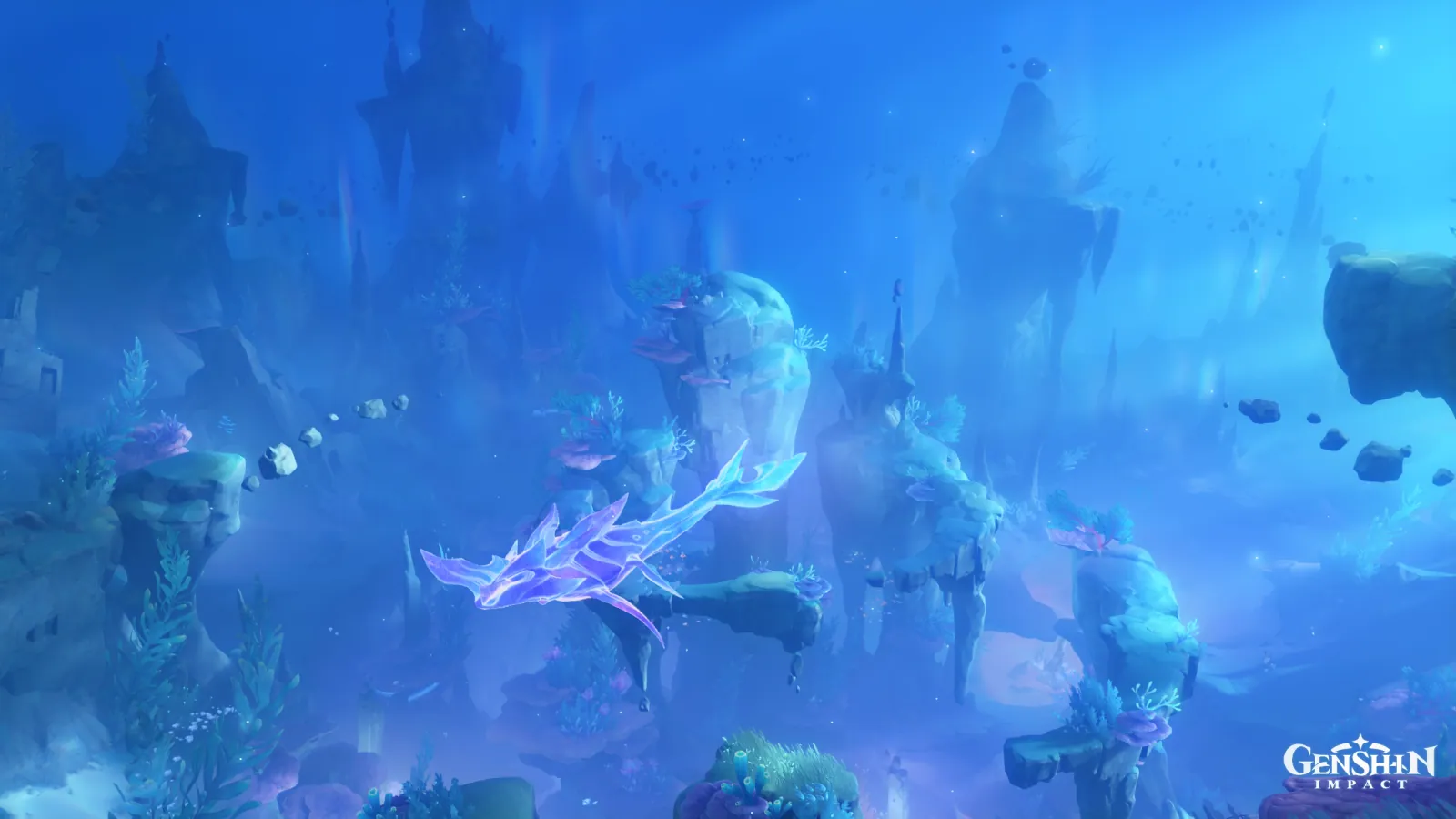
Sea of Bygone Eras in Sunken Daylight
FontaineDayBoundlessForgottenStill Blue

Sea of Bygone Eras in Sunken Daylight

Palette

Click a swatch to copy its HEX; hover for the OKLCH value.

Reconstructed gradient

The gradient distilled from the scene, unrolled left to right by stop; the authored angle is 175° (used by the hero and exports), while gallery cards share a uniform 135° sweep.

0%7fe5ff38%2277e370%5869fa100%3571c3

Why it works

Loudness is decided by contrast, not by chroma. This is the most saturated picture in the library — median 0.153, achromatic pixels 0.00%, 99.2% one blue family — and it still reads as quiet, because the high chroma was raised across the whole frame, leaving nothing that stands out for it.

01

A median chroma of 0.153, not a single point

Chroma runs p50 0.153, p99 0.196, peak 0.245: half the pixels here are more vivid than most scenes' accent colours. But the lift is uniform — the upper water 0.183, the foreground reef 0.142, the most vivid patch 0.215, a spread of only 0.07. Chroma is a property of the environment here, not a device for emphasis. If you want rich without shrill, push every colour up together and leave no single richer one to serve as a target.

02

Zero grey, zero warmth — even the boundaries are hue

Achromatic pixels total 0.00%, and a 330°–90° warm search over the whole frame returns nothing at all: the water has filtered out the grey and the warmth alike. What is left for separation is a small swing of hue — the light shafts 217°, the water 257°, the most vivid patch 273°, the drifting bioluminescence 283°. Sixty-six degrees of travel carries every layer in the picture. The Salacia Plain study said the medium is a filter; this one is what that filter looks like opened all the way.

03

The brightest place is the highest, and it gives up its chroma

The brightest four thousand pixels average L 0.87 at chroma 0.102, spread across the shafts and scatter around (0.53, 0.55) and (0.78, 0.72) — nearly half the water's 0.183. Light arrives from above, so the shorter its path through water the less it is dyed, which makes "bright" a synonym for "near the surface" in this picture. Lightness therefore doubles as a depth gauge: the span from 0.44 to 0.82 reads as surface to seabed.

Take these colours with you

CSS variables, a Tailwind v4 theme or SVG — one click to copy into your project.

/* Sea of Bygone Eras in Sunken Daylight · Sea of Bygone Eras in Sunken Daylight — Teyvat Palette */
:root {
  --seafloor-blue: oklch(0.55 0.142 257); /* Seafloor Blue #3571c3 */
  --sunken-blue: oklch(0.58 0.183 257); /* Sunken Blue #2277e3 */
  --abyss-violet: oklch(0.59 0.215 273); /* Abyss Violet #5869fa */
  --whale-glow: oklch(0.65 0.19 283); /* Whale Glow #8379fd */
  --light-shaft: oklch(0.87 0.102 217); /* Light Shaft #7fe5ff */
  --gradient-sea-of-bygone-eras: linear-gradient(175deg, oklch(0.87 0.102 217) 0%, oklch(0.58 0.183 257) 38%, oklch(0.59 0.215 273) 70%, oklch(0.55 0.142 257) 100%);
}

A 1080×1350 PNG carrying the scene, its palette and every value — save it and post it as is.