Teyvat PaletteTeyvat colour cards
Scene library
GitHub
Gallery
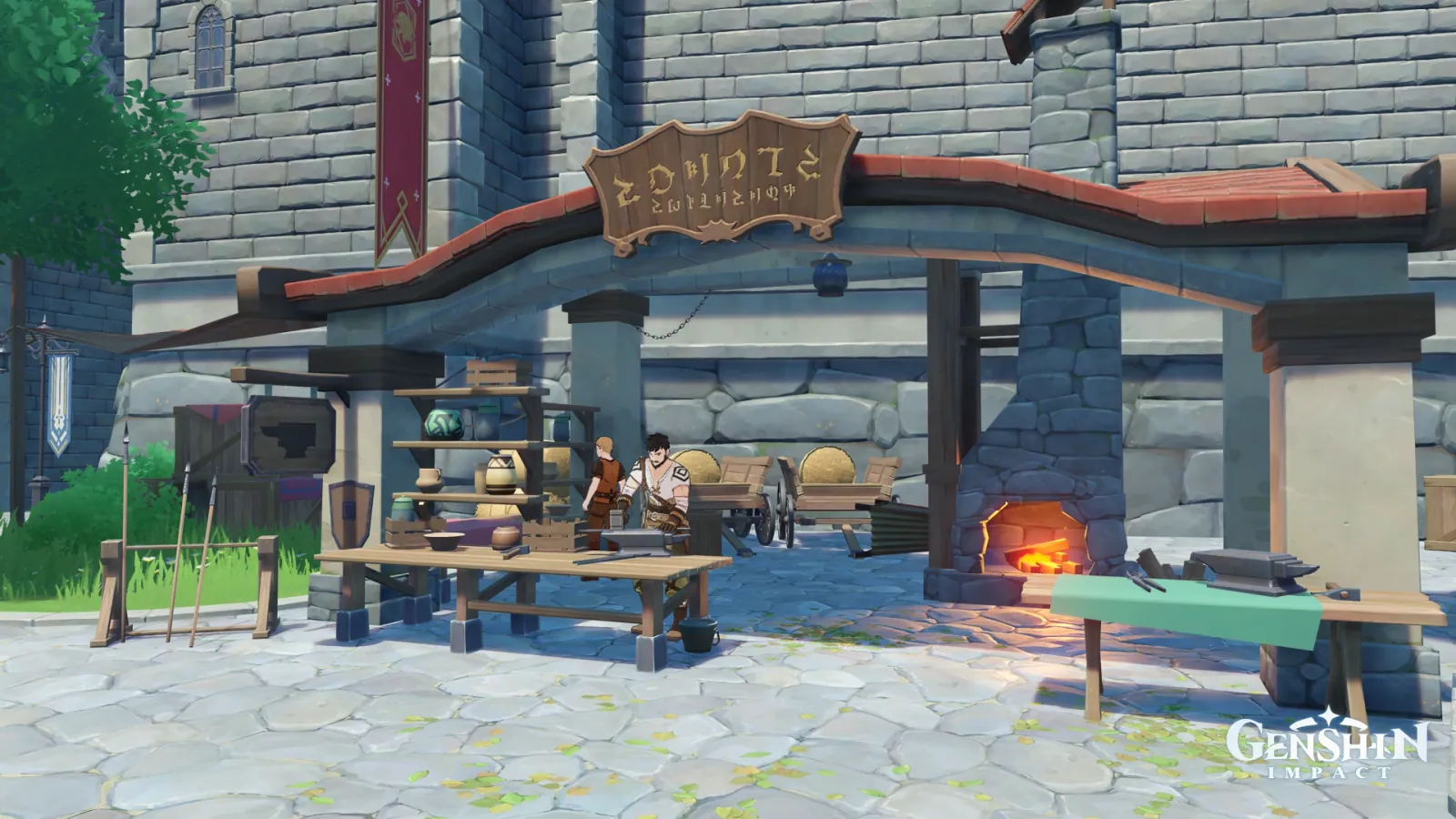
Schulz's Blacksmith by Forge Light
MondstadtDayWorkadayHandmadeForge-warm

Schulz's Blacksmith by Forge Light

Palette

Click a swatch to copy its HEX; hover for the OKLCH value.

Reconstructed gradient

The gradient distilled from the scene, unrolled left to right by stop; the authored angle is 180° (used by the hero and exports), while gallery cards share a uniform 135° sweep.

0%4b656f62%c6684774%cfbdb486%a8bcba100%bacbcb

Why it works

Only hue can say "there is a lamp there"; lightness not only fails to help, it says the opposite. Sample the same paving three times: in daylight L 0.83 at hue 194°, shaded under the shed roof L 0.78 at 190°, directly in front of the forge mouth L 0.81 at 49°. All three lightnesses fall inside 0.05 of each other and all three chromas inside 0.005 (0.019 / 0.022 / 0.024). The only channel that can rank "where the light is" is that 145° flip of hue.

01

Three flagstones, and lightness cannot rank them

Mid-square, under open daylight, the paving measures L 0.83, chroma 0.019, hue 194°. The same paving shaded beneath the shed roof measures L 0.78, 0.022, 190° — 0.05 darker, with hue moved by just 4°. Occlusion leaves almost no signature in hue. Straight in front of the forge mouth it reads L 0.81, 0.024 — and 49°. Step one further toward the fire and lightness actually drops to 0.67, chroma rises to 0.057, hue lands at 28°: the closer to the lamp, the darker. If you want a picture to say "there is a lamp here", do not try to brighten the ground under it — brightness belongs to occlusion and composition and may run backwards. Twist that patch of ground toward the lamp's hue instead.

02

A lamp grants no dominant colour, only a ceiling

The fire in the forge measures L 0.62, chroma 0.128, and its peak of 0.225 is the whole frame's chroma ceiling. Yet the frame's chroma median is only 0.021, below the 0.025 achromatic threshold, and 55.14% of pixels count formally as grey. All eight hue bands are present, and the largest of them, blue, holds just 21.34%. It is the exact counterpart of Wangshan Hall, Main Hall in Thin Teal: that room's median of 0.026 also hugged the achromatic line, 47.66% of it counted as grey, and it still read unmistakably as a teal hall, because 270°–45° held not one pixel. Here all eight families are seated and every one of them is contradicted, so "what colour is this place" has no answer at all — only "there is a lamp there".

03

Rank by chroma and the grass wins

Of the 4,000 most chromatic pixels in the frame, 2,066 fall on the small patch of grass at the foot of the wall on the left (hue 134°, chroma 0.141). The forge fire takes only 1,233 (41°, chroma 0.159). A chroma ranking cannot find the light source: the grass has more pixels near the ceiling than the fire does, and nobody would call this a picture about grass. And the grass at 134° sits only 60° from the sunlit paving's 194°, while the two flagstones are 145° apart. To find the light, pick one material that appears twice in the frame and measure the hue difference between its two appearances — do not sort by chroma.

Take these colours with you

CSS variables, a Tailwind v4 theme or SVG — one click to copy into your project.

/* Schulz's Blacksmith by Forge Light · Schulz's Blacksmith by Forge Light — Teyvat Palette */
:root {
  --curtain-wall: oklch(0.49 0.035 223); /* Curtain Wall #4b656f */
  --sunlit-flagstone: oklch(0.83 0.019 194); /* Sunlit Flagstone #bacbcb */
  --shed-flagstone: oklch(0.78 0.022 190); /* Shed Flagstone #a8bcba */
  --forge-lit-stone: oklch(0.81 0.024 49); /* Forge-lit Stone #cfbdb4 */
  --forge-fire: oklch(0.62 0.128 40); /* Forge Fire #c66847 */
  --wall-grass: oklch(0.46 0.082 151); /* Wall Grass #326540 */
  --gradient-schulzs-blacksmith: linear-gradient(180deg, oklch(0.49 0.035 223) 0%, oklch(0.62 0.128 40) 62%, oklch(0.81 0.024 49) 74%, oklch(0.78 0.022 190) 86%, oklch(0.83 0.019 194) 100%);
}

A 1080×1350 PNG carrying the scene, its palette and every value — save it and post it as is.