Teyvat PaletteTeyvat colour cards
Scene library
GitHub
Gallery
Sand-Embraced Home in Dust Haze
SumeruSallowSilentBarren

Sand-Embraced Home in Dust Haze

Palette

Click a swatch to copy its HEX; hover for the OKLCH value.

Reconstructed gradient

The gradient distilled from the scene, unrolled left to right by stop; the authored angle is 180° (used by the hero and exports), while gallery cards share a uniform 135° sweep.

0%9a8f6830%7d714c52%757c5074%daa433100%4a2a09

Why it works

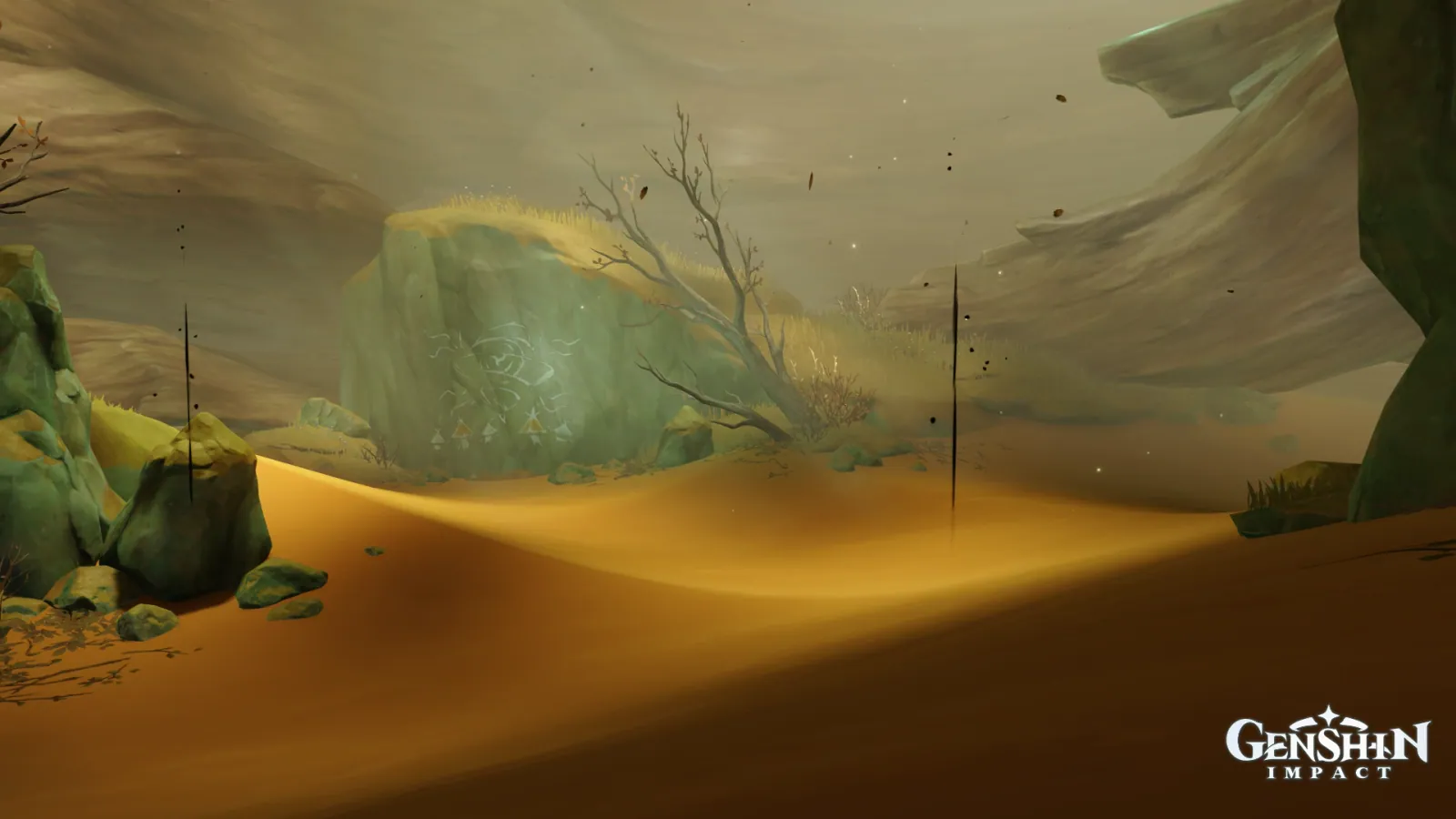
Air does not merely push colour toward itself; it is the point the whole picture's gamut converges on. The dust of Sand-Embraced Home measures 94°, and the frame's two families of material walk toward it from opposite sides — the same rock reads 116° near and 93° at maximum distance; the same sand reads 63° in the foreground and 86° at its farthest edge. Two things 53° apart up close are 7° apart far away. To narrow a picture's gamut, you do not have to touch the objects: put the hue of the medium between the two families.

01

Two families pulled to one number, from both sides

The same carved boulder reads 110° on its near face (from (0.26, 0.36)) and 116° over the whole mass. The farthest cliff (from (0.72, 0.10)) is 93°, its top (from (0.78, 0.05)) 98° — all the way toward the dust's 94°, while lightness barely moves (0.57 → 0.55). The sand walks the other way: the shaded dune face (from (0.35, 0.85)) 63°, the middle stretch (from (0.72, 0.55)) 78°, the farthest edge (from (0.80, 0.50)) 86°. 〈Alcor in Thin Haze〉 measured the one-sided half of this — that picture's sky is 239° and 92.5% of the hull's pixels were pushed into 210°–270°. Here the medium's hue sits between the two families, so both sides are drawn in at once.

02

The bill is charged almost entirely to hue

The convergence is not paid for in chroma: the rock goes 0.064 → 0.055 from near to far, the sand 0.065 → 0.063 — spreads of 0.009 and 0.002, while each walks 23° of hue. Lightness does not carry the bill either; the rock's near and far differ by 0.02. The dust itself is the quietest step in the picture: the sky (from (0.35, 0.02)) is L 0.65 / C 0.056, and the peak across those 41,472 pixels is only 0.062, less than half the frame's ceiling of 0.154. It is also the brightest large surface in the picture. "Quiet" is a fact about chroma, not about lightness.

03

A 190° window of nothing, and five colours

The price is the gamut: the window `190°–20°`, 190° wide, holds zero pixels in the whole frame; widen it to 210° (`180°–30°`) and there is 1 pixel; to 240° (`165°–45°`) and there are 42. 99.64% of the picture is packed into the 120° between 45° and 165°. The 180° void of 〈Fane of Ashvattha, Moonpale〉 is one of the library's hardest such claims, and the 255° of 〈Spiritstone in a Lone Light〉 is the ceiling — Sand-Embraced Home reaches 190° in an ordinary outdoor landscape. And a viewer still reads orange sand, cyan rock, brown sky, yellow grass, white carving: the number of colour names has nothing to do with the span of hue. To make a set of assets look like one place, do not go and unify their hues — give them one shared body of air.

Take these colours with you

CSS variables, a Tailwind v4 theme or SVG — one click to copy into your project.

/* Sand-Embraced Home in Dust Haze · Sand-Embraced Home in Dust Haze — Teyvat Palette */
:root {
  --dust-veil: oklch(0.65 0.056 94); /* Dust Veil #9a8f68 */
  --carved-rock: oklch(0.57 0.064 116); /* Carved Rock #757c50 */
  --sun-struck-sand: oklch(0.75 0.138 81); /* Sun-Struck Sand #daa433 */
  --deep-sand: oklch(0.32 0.065 63); /* Deep Sand #4a2a09 */
  --far-wall: oklch(0.55 0.055 93); /* Far Wall #7d714c */
  --gradient-sand-embraced-home: linear-gradient(180deg, oklch(0.65 0.056 94) 0%, oklch(0.55 0.055 93) 30%, oklch(0.57 0.064 116) 52%, oklch(0.75 0.138 81) 74%, oklch(0.32 0.065 63) 100%);
}

A 1080×1350 PNG carrying the scene, its palette and every value — save it and post it as is.