Teyvat PaletteTeyvat colour cards
Scene library
GitHub
Gallery
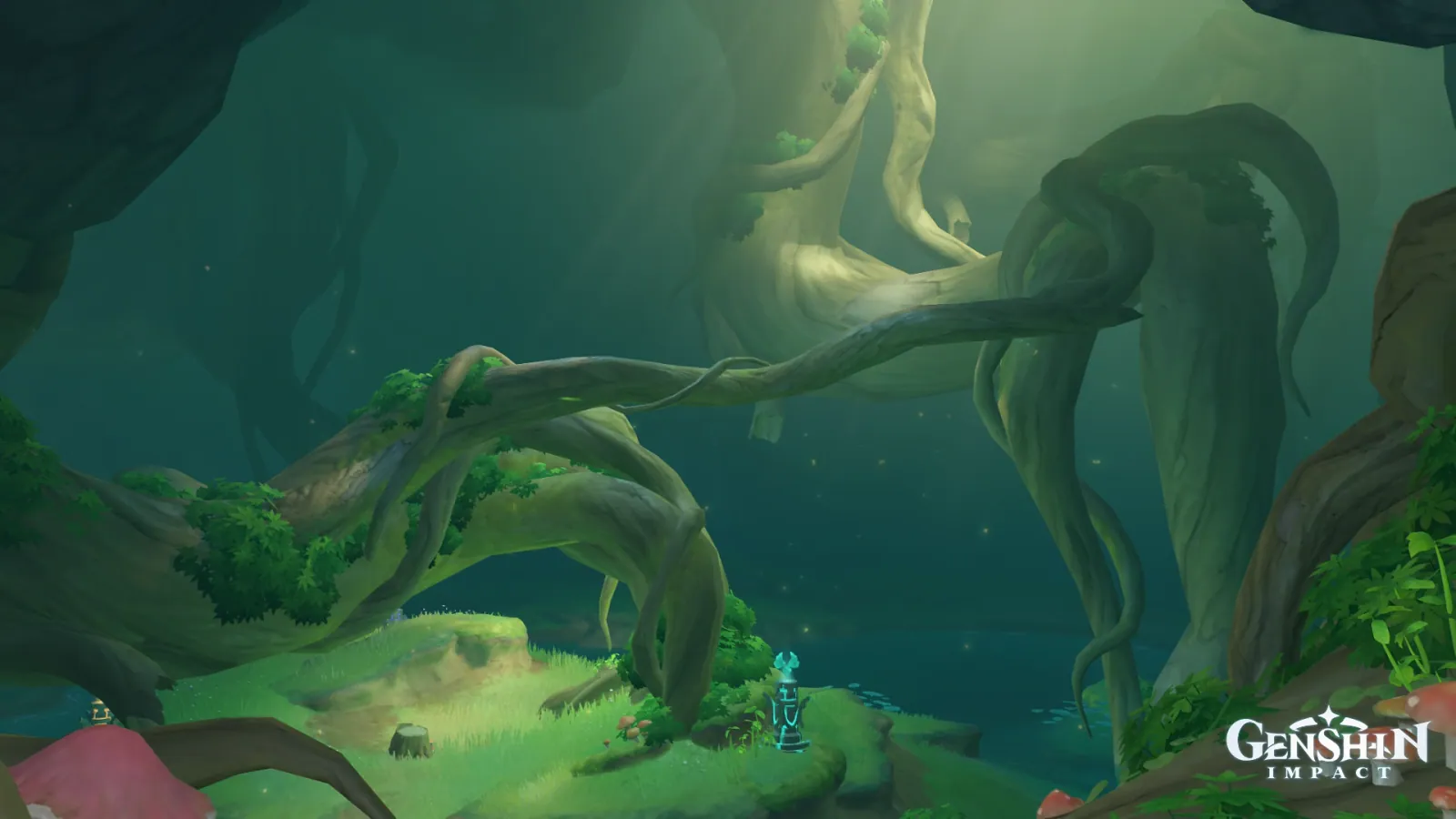
Roots of the Valley of Life in Filtered Green
LiyueDeepMoistVerdigris

Roots of the Valley of Life in Filtered Green

Palette

Click a swatch to copy its HEX; hover for the OKLCH value.

Reconstructed gradient

The gradient distilled from the scene, unrolled left to right by stop; the authored angle is 180° (used by the hero and exports), while gallery cards share a uniform 135° sweep.

0%b8c58e30%748f6a62%164940100%59a143

Why it works

Once a light has taken both the lightness channel and the hue channel, chroma is the only channel left that can still report what a thing is — and it has to come from the material itself. Here, the further from the light, the more the hue turns cyan and the lower the lightness falls (137° / 154° / 161° / 179° / 183° against L 0.62 / 0.40 / 0.43 / 0.37 / 0.36); yet the chroma of those five places reads 0.063 / 0.064 / 0.065 / 0.056 / 0.051, a spread of 0.014. The one that breaks rank is the mound of grass the light lands on: at almost the same depth as the base of the shaft (138° against 137°, L 0.59 against 0.62), its chroma of 0.103 is 1.6 times as high.

01

The light itself is green

The shaft leaking in from above looks warm white; measured, it is green. Of the 4000 brightest pixels, 878 are centred on (0.63, 0.30) and 800 on (0.57, 0.32), both on the shaft, at L 0.80 / 0.82, C 0.075 / 0.081, hue 119° / 115°; the base of the shaft (from (0.55, 0.02)) is 137°. Across the whole frame the window `200°–100°`, 260° wide, holds only 12,000 pixels (1.36%), and 10,075 of them are the cluster of mushrooms in the lower left corner (12°). The light was dyed by the canopy overhead before it ever entered the frame, so nothing in this cavern can report the colour of the sun.

02

How far from the light is said by hue and lightness together

Walking from the light into the depths: the base of the shaft (from (0.55, 0.02)) 137° / L 0.62; the lit mound of grass (from (0.30, 0.80)) 138° / 0.59; the near ground at left (from (0.15, 0.55)) 154° / 0.40; the great root in the middle distance (from (0.35, 0.50)) 161° / 0.43; the right rear (from (0.62, 0.55)) 179° / 0.37; the deepest point at left (from (0.08, 0.15)) 183° / 0.36. The green band at 54.15% (148°) and the cyan band at 44.25% (181°) split 98.40% of the picture between them — but those two bands are not two materials. They are one set of materials at two distances from the light. 〈The Chasm: Underground Mines toward a Distant Glow〉 is the exact inverse: there the hue is pinned to 210°–217° the whole way, and depth is walked by lightness and chroma tied to one slider.

03

Chroma is the channel left for the material

The chroma of those six places reads 0.063 / 0.103 / 0.064 / 0.065 / 0.056 / 0.051 — drop the grass and the spread is 0.014, wildly out of proportion to the 46° of hue and 0.26 of lightness they cover. The grass breaks rank on that channel alone: 3,999 of the frame's 4000 most chromatic pixels fall in 120°–150°, centred on (0.54, 0.84), averaging 0.148, with the frame's peak of 0.200 there as well — and its lightness of 0.59 is lower than the 0.62 at the base of the shaft. 〈Paha Isle by Cavern Glow〉 is the reverse of this: there the whole lightness channel was taken by "how far from the light", so depth had to be re-hung on chroma. Read together they make one rule: "how far from the light" and "what this is" must occupy different channels, and whichever claims one first leaves the other only what remains. To make something legible in a scene ruled by a light, do not touch its lightness or its hue — give it half again the chroma of its neighbours.

Take these colours with you

CSS variables, a Tailwind v4 theme or SVG — one click to copy into your project.

/* Roots of the Valley of Life in Filtered Green · Roots of the Valley of Life in Filtered Green — Teyvat Palette */
:root {
  --shaft-green: oklch(0.8 0.075 119); /* Shaft Green #b8c58e */
  --lit-turf: oklch(0.64 0.148 139); /* Lit Turf #59a143 */
  --root-cyan: oklch(0.43 0.065 161); /* Root Cyan #2b5b44 */
  --abyss-cyan: oklch(0.36 0.051 183); /* Abyss Cyan #184640 */
  --cap-red: oklch(0.44 0.058 23); /* Cap Red #6f4643 */
  --gradient-roots-of-the-valley-of-life: linear-gradient(180deg, oklch(0.8 0.075 119) 0%, oklch(0.62 0.063 137) 30%, oklch(0.37 0.056 179) 62%, oklch(0.64 0.148 139) 100%);
}

A 1080×1350 PNG carrying the scene, its palette and every value — save it and post it as is.