Teyvat PaletteTeyvat colour cards
Scene library
GitHub
Gallery
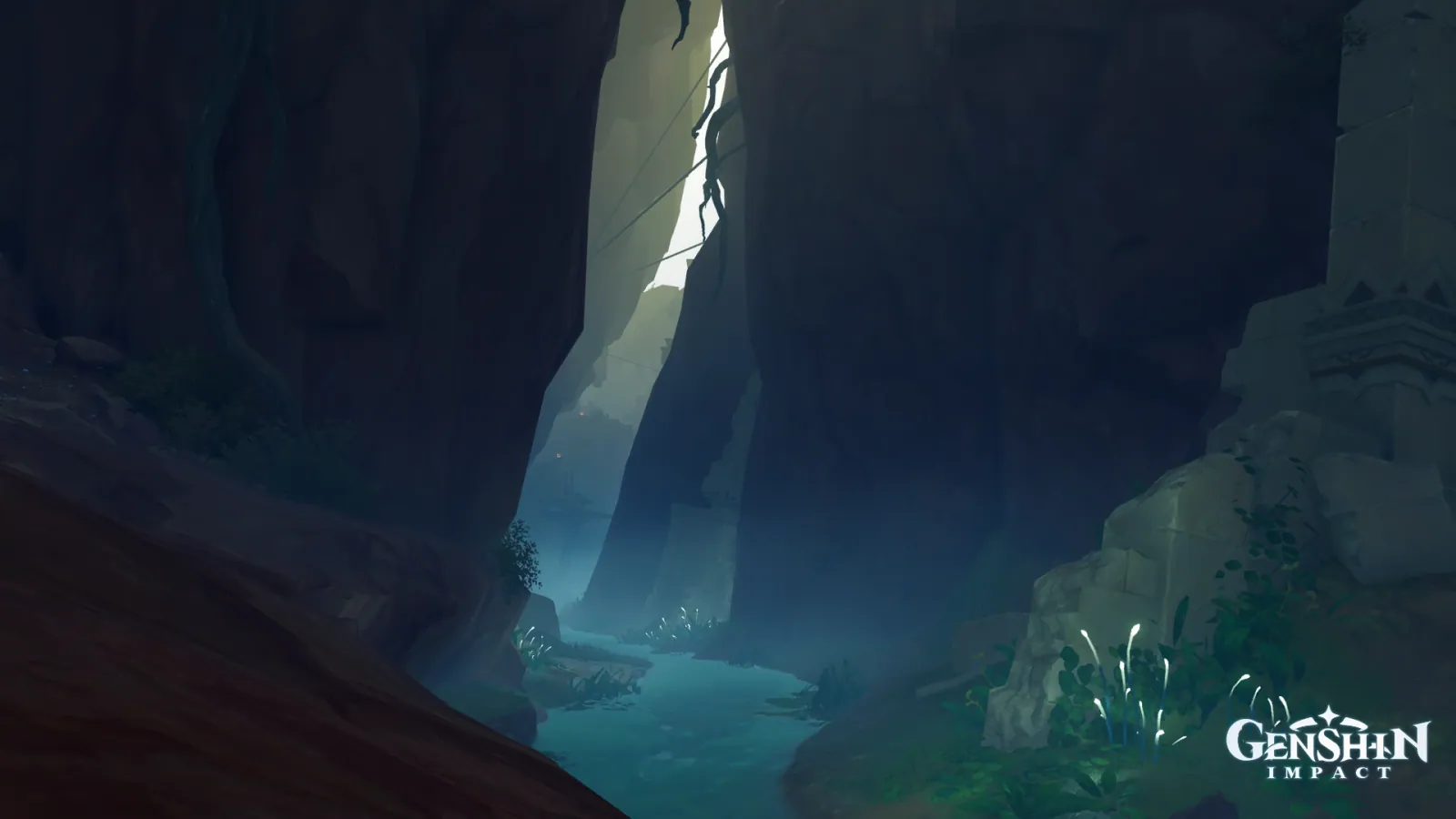
Pairidaeza Canyon in a Sliver of Light
SumeruDayEnclosedForbiddingDamp cold

Pairidaeza Canyon in a Sliver of Light

Palette

Click a swatch to copy its HEX; hover for the OKLCH value.

Reconstructed gradient

The gradient distilled from the scene, unrolled left to right by stop; the authored angle is 180° (used by the hero and exports), while gallery cards share a uniform 135° sweep.

0%e7ede914%69756a32%182c4450%15202e66%10162386%2b6373100%1c1318

Why it works

In a dark scene, adding light is not the same as adding colour: Pairidaeza Canyon is the most strongly lit of these four — 2680 of its brightest 4000 pixels sit at L 0.94 and another 1108 at L 0.95 — and yet its chroma ceiling is only 0.084, half of the other three at 0.156 / 0.161 / 0.164. The difference is not grey: its 24.53% achromatic ranks third of the four, and the greyest picture of the set (53.76%) does not drop its ceiling at all. The difference is what this light landed on. The only thing it touches directly is the cliff wall itself, and sampled at three heights that wall reads L 0.50 / chroma 0.023, L 0.51 / 0.024, L 0.66 / 0.023 — lightness travels 0.16 while chroma stays nailed below the achromatic threshold of 0.025 the whole way. To get colour into a dark scene, don't add another lamp; give the lamp something coloured to land on.

01

The same kind of white opening, and a ceiling twice as high

Pairidaeza's sliver of sky is white at chroma 0.008 (its brightest 2680 pixels at L 0.94); the skylight in Liloupar's Cell under the Skylight is white at chroma 0.004 (its brightest 3803 pixels at L 1.00). Both lights are colourless, both are the only source, both enter through a hole overhead. The only difference is what they reach: in Liloupar's Cell the light lands on a canopy whose lit half measures L 0.66 / chroma 0.101, and the ceiling is 0.161; in Pairidaeza the light lands on nothing but bare rock at L 0.51 / chroma 0.024, and the ceiling is 0.084. The ceiling is the lit surface's own colour, not the light's brightness — the same torch aimed at green leaves and at a concrete wall gives you two pictures a full factor apart.

02

The chroma has to come from where the light doesn't reach

Of the 4000 most chromatic pixels, 3617 fall in 210°–240° at a mean of L 0.53 / chroma 0.071, centred at (0.45, 0.78) — the pool on the canyon floor, which measured alone is L 0.47 / chroma 0.064 / 219° and lies entirely in shadow. The second most chromatic thing is the sheet of canyon haze at L 0.29 / chroma 0.051 / 253°. Land of Lower Setekh in Thin Daylight said that to find a picture's most saturated place you should look where the sun isn't — but that study assumed a second, coloured light source. Here there is none: the shadow's colour is the blue from the sliver of sky, scattered a second time. The most saturated thing a single white light can offer in a dark scene is its spill, not its beam.

03

Everything that looks warm adds up to 370 pixels

The big slope at lower left reads as red-brown rock; it measures L 0.20 / chroma 0.018 / 344°, below the achromatic line. The glowing plants in the lower right hold only 189 of the brightest 4000 pixels at chroma 0.024–0.028, achromatic as well. And the whole frame carries roughly 370 pixels in 330°–90°, whose most saturated 3% — 11 pixels — reach only chroma 0.042. The price of a ceiling pressed down to 0.084 is not that the picture turns grey: the blue band covers 62.94% and the eye separates every object cleanly. The price is that the picture has no absolute colour left in it — warmth, brightness and dirtiness are all decided by ranking now.

Take these colours with you

CSS variables, a Tailwind v4 theme or SVG — one click to copy into your project.

/* Pairidaeza Canyon in a Sliver of Light · Pairidaeza Canyon in a Sliver of Light — Teyvat Palette */
:root {
  --sky-sliver: oklch(0.94 0.008 158); /* Sky Sliver White #e7ede9 */
  --lit-wall: oklch(0.55 0.023 146); /* Lit Wall #69756a */
  --canyon-haze: oklch(0.29 0.051 253); /* Canyon Haze Blue #182c44 */
  --cliff-shadow: oklch(0.24 0.032 256); /* Cliff Shadow Blue #15202e */
  --near-cliff: oklch(0.2 0.029 265); /* Near Cliff Violet #101623 */
  --pool-teal: oklch(0.47 0.064 219); /* Pool Teal #2b6373 */
  --fore-slope: oklch(0.2 0.018 344); /* Foreslope Brown #1c1318 */
  --gradient-pairidaeza-canyon: linear-gradient(180deg, oklch(0.94 0.008 158) 0%, oklch(0.55 0.023 146) 14%, oklch(0.29 0.051 253) 32%, oklch(0.24 0.032 256) 50%, oklch(0.2 0.029 265) 66%, oklch(0.47 0.064 219) 86%, oklch(0.2 0.018 344) 100%);
}

A 1080×1350 PNG carrying the scene, its palette and every value — save it and post it as is.