Teyvat PaletteTeyvat colour cards
Scene library
GitHub
Gallery
Nasha Town, Blazing Noon
DayClamorousContraptionSuspended

Nasha Town, Blazing Noon

Palette

Click a swatch to copy its HEX; hover for the OKLCH value.

Reconstructed gradient

The gradient distilled from the scene, unrolled left to right by stop; the authored angle is 180° (used by the hero and exports), while gallery cards share a uniform 135° sweep.

0%51b4fa26%dd5da348%436a9e66%775c5784%414260100%a1a7ba

Why it works

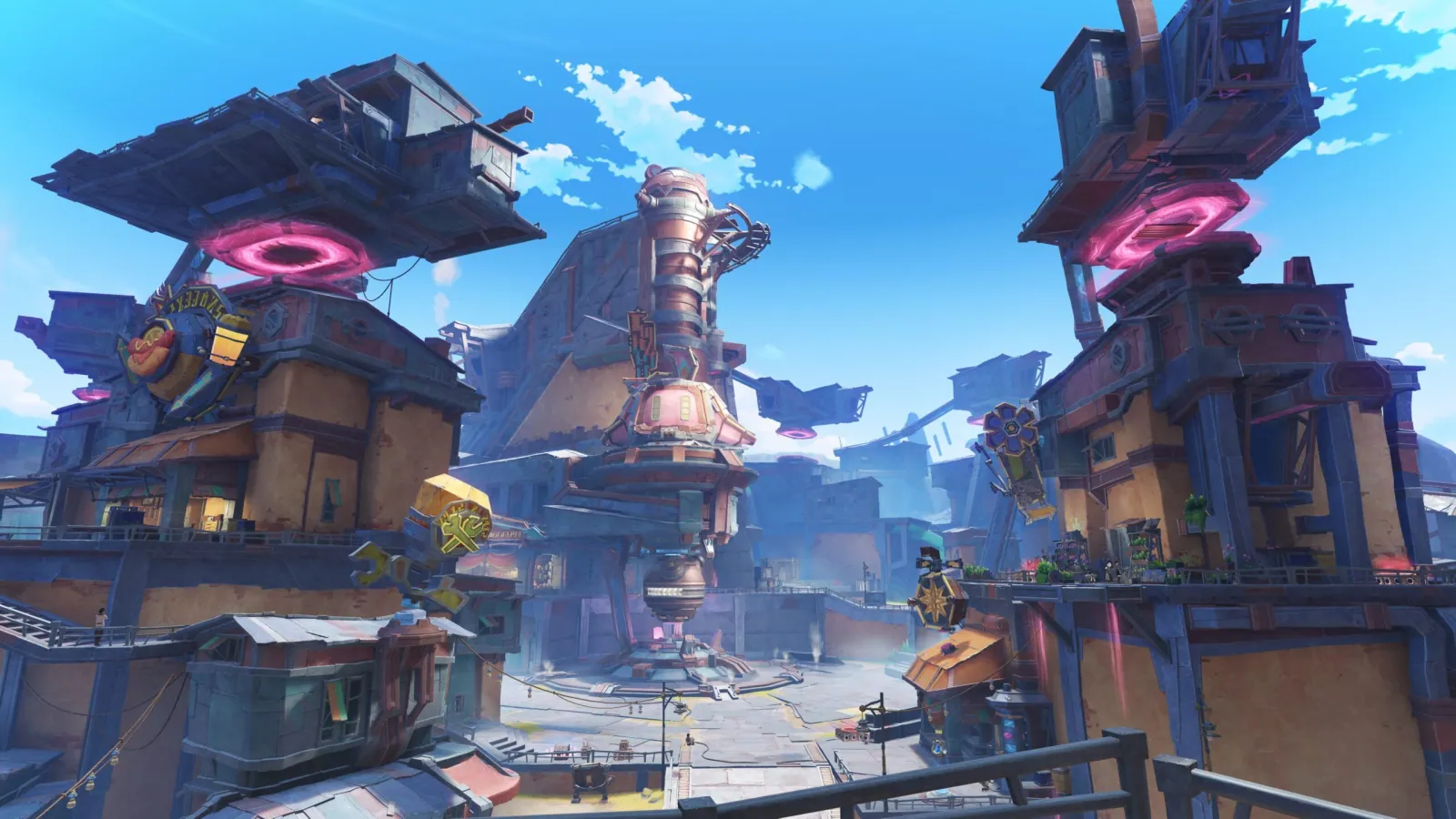
Two identical chroma peaks hand the focus to their midpoint, and the thing at that midpoint may hold no extreme at all. The most chromatic 3% of the two antigravity rings read chroma 0.178 and 0.175, hue 350° and 348°, lightness 0.65 and 0.68. Of the frame's most chromatic 4000 pixels, 3500 fall in that 330°–360° band, and the centroid the bench reports is (0.49, 0.29) — the tower at dead centre. There, 315°–360° holds only 1289 pixels at a mean chroma of 0.049, below the frame median of 0.063. If you want something quiet to lead, do not strengthen it: set two equally strong things symmetrically on either side of it. The more alike they are, the harder the midpoint gets.

01

The two rings read the same numbers

The left ring (from 0.15, 0.27) is 6063 pixels at L 0.52 / chroma 0.118 / hue 334°, peaking at 0.192; the right ring (from 0.73, 0.23) is 6579 pixels at L 0.48 / 0.102 / 331°, peaking at 0.199. Take the most chromatic 3% of each and you get 182 pixels at L 0.65 / 0.178 / 350° against 197 pixels at L 0.68 / 0.175 / 348°. The frame's chroma ceiling of 0.199 sits on the right ring, and the left ring misses it by 0.007. Reading the same number on all three channels, neither one is more the 'most chromatic place' than the other — 〈Great Hall of Truths, Firelight〉had two braziers do this in lightness (0.84 against 0.84); here it is done in chroma.

02

There is not one pink pixel at the centroid

The frame holds 35590 pixels (4.04%) in 315°–360°, and their most chromatic 3% (1068 pixels) averages 0.173. Yet box in the whole central tower (from 0.42, 0.22, 18079 pixels) and only 1289 of them fall in 315°–360°, at a mean chroma of 0.049 — below the frame median of 0.063 — with a peak of 0.086, less than half either ring. Widen the box to the central 40%×30% (from 0.30, 0.15) and it is still only 2650 pixels, 7.4% of that band. The tower itself measures L 0.65 / chroma 0.083, both channels only a shade above the median. (0.49, 0.29) is a computed position, not a measured one: it is the coordinate the two rings averaged into, and there is precisely nothing there.

03

What takes over is a position, not another colour

〈Tribal Secret Space of the Collective of Plenty, Dim Torches〉said that after two lights cancel each other, composition decides who takes over — there it was a converging stair. Here even the path is dispensed with: the two rings hang on the same horizontal line, equidistant from the central axis, and the identity 'most chromatic' is flattened into a single coordinate. The corroboration is that nothing else in the picture could take over — the deepest zenith inside 57.77% of blue reaches only 0.138, the 20.74% of violet averages 0.051, the wall that looks most warm of all (from 0.13, 0.44) measures L 0.37 / chroma 0.033, and 45°–105° holds just 14019 pixels across the whole frame at a mean of 0.053. Interfaces work the same way: to make a main region stand out when it cannot glow on its own, pin two identically weighted strong elements symmetrically on either side of it rather than outlining or tinting it.

Take these colours with you

CSS variables, a Tailwind v4 theme or SVG — one click to copy into your project.

/* Nasha Town, Blazing Noon · Nasha Town, Blazing Noon — Teyvat Palette */
:root {
  --ring-core: oklch(0.66 0.176 349); /* Ring Core #dd5da3 */
  --ring-halo: oklch(0.52 0.118 334); /* Ring Halo #914c85 */
  --town-zenith: oklch(0.74 0.138 243); /* Town Zenith #51b4fa */
  --gantry-steel: oklch(0.52 0.094 256); /* Gantry Steel #436a9e */
  --tower-shade: oklch(0.39 0.051 283); /* Tower Shade #414260 */
  --mud-wall: oklch(0.5 0.037 30); /* Mud Wall Ochre #775c57 */
  --plaza-pale: oklch(0.73 0.028 270); /* Plaza Pale #a1a7ba */
  --gradient-nasha-town: linear-gradient(180deg, oklch(0.74 0.138 243) 0%, oklch(0.66 0.176 349) 26%, oklch(0.52 0.094 256) 48%, oklch(0.5 0.037 30) 66%, oklch(0.39 0.051 283) 84%, oklch(0.73 0.028 270) 100%);
}

A 1080×1350 PNG carrying the scene, its palette and every value — save it and post it as is.