Teyvat PaletteTeyvat colour cards
Scene library
GitHub
Gallery
Hiisi Island in the Last Light
Nod-KraiColdEmptyFaint Glow

Hiisi Island in the Last Light

Palette

Click a swatch to copy its HEX; hover for the OKLCH value.

Reconstructed gradient

The gradient distilled from the scene, unrolled left to right by stop; the authored angle is 45° (used by the hero and exports), while gallery cards share a uniform 135° sweep.

0%1e275d55%223b8678%3655d7100%d9cbff

Why it works

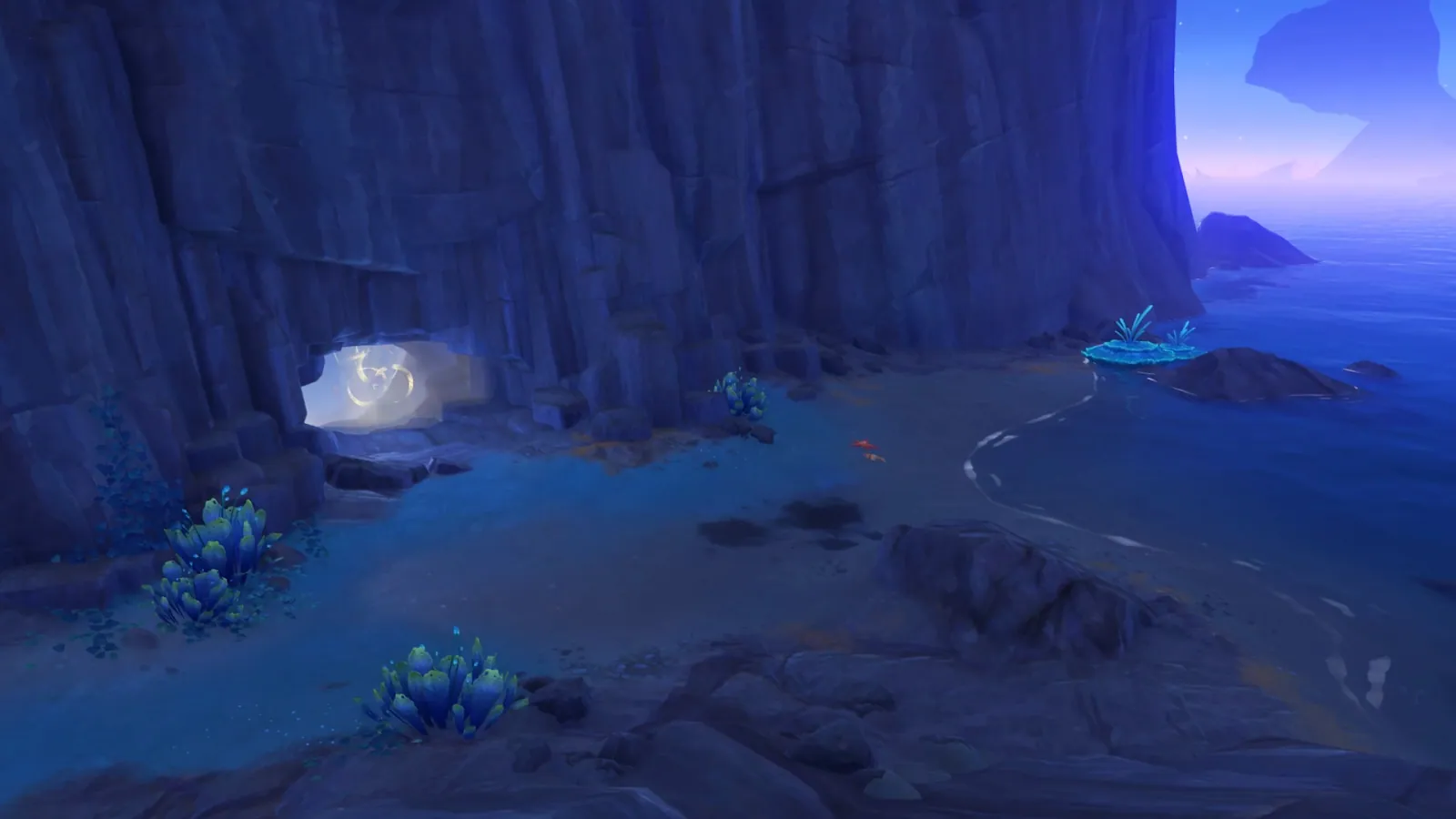
Lightness can tie; neutrality cannot. The sky takes 3796 of the frame's 4000 brightest pixels (L 0.87, chroma 0.070 and 0.074), leaving the glowing sigil on the cliff just 204 of them — and its lightness of 0.88 is only 0.01 higher. What separates the two surfaces is chroma: 0.015 against 0.074. Only 0.10% of the frame is achromatic, where 〈Mt. Laixin in Drifting Haze〉, the picture whose grey was scarcest, still had 2.67%. At that scarcity, 204 pixels are enough to be a picture's only light. To make something glow, don't compete for brightest — compete for being the one thing in the frame with no hue.

01

The brightest thing is not the light, it is the sky that is left

The 4000 brightest pixels split into two places. 3796 of them sit in the light left between sea and sky at the upper right, at (0.86, 0.19) and (0.87, 0.21), mean L 0.87, chroma 0.070 and 0.074, hues 294° and 301°. Only 204 sit on the sigil halfway up the cliff at (0.25, 0.46), L 0.88, chroma 0.015. On lightness the two cannot be told apart, and the sigil's 204 pixels are already below the achromatic threshold of 0.025 — while only 0.10% of the whole frame manages that. So this picture cannot judge what is glowing by brightness: the sky has not gone dark yet, and the sky is the brightest thing in it. The time field is left empty for the same reason — the last light reads neither as dusk nor as dawn, and 330°–90° holds only 70 pixels across the frame: nothing a warm evening sky would leave behind is here.

02

The sigil is violet; only its core is white

Fence in the sigil together with the ring of rock it has lit (0.23,0.42,0.06,0.06) and the block reads L 0.70, chroma 0.047, 273°; take the most chromatic 3% of that block and it is 269°, chroma 0.103 — even the most saturated pixels on its own ground are still violet. Widen to 0.20,0.38,0.14,0.16 and count only the warm pixels in 330°–90°: there are none. That gold was not painted in. It is the 204 pixels at the core that gave up their chroma, plus the complement the surrounding 273° field supplies on their behalf. 〈Voidsea Outlook in Cavern Blue〉 measured the same thing: 89.65% of that cavern's pixels lie in 210°–270°, its opening reads chroma 0.024, and all the gold in the frame came to 441 pixels. Here it is harsher — the whole frame holds 70 pixels in 330°–90°, and measuring the little crab midway along the sand on its own (0.57,0.51,0.05,0.05) returns the same 70, mean 349°, chroma 0.064. Every warm pixel in this picture is that one crab, and it is paler than the frame's own chroma median of 0.095.

03

Everything on the ground is the same colour

The cliff face is L 0.30, chroma 0.096, 272°. The clumps of crystal fern on the shore are L 0.32, chroma 0.093, 259°. The sand inside the tide line is L 0.32, chroma 0.080, 267° — three entirely unrelated materials, 0.02 apart in lightness, 0.016 in chroma, and 13° of hue between all of them. 99.80% of the frame is packed into 210°–315°, and the 150°-wide window from 15° to 165° holds 75 pixels. 〈Hiisi Island by Night Glow〉, on the same island, has a chroma median of 0.175 and 0.27% achromatic, and concluded that white is rationed strictly to the brightest emitters — its 4000 brightest pixels scatter across seven cells at L 0.96–0.97 and chroma 0.020–0.031, all of them emitters, so 'brightest' and 'palest' were the same batch of pixels and there was no telling which one was doing the work. This picture pulls the two apart: the sky takes brightest, the sigil takes only palest, and the one read as light is the second. So to make an element glow, it need not be brighter than the background — the background may even be brighter. What has to hold is that it is the only thing in the frame that gave up its hue.

Take these colours with you

CSS variables, a Tailwind v4 theme or SVG — one click to copy into your project.

/* Hiisi Island in the Last Light · Hiisi Island in the Last Light — Teyvat Palette */
:root {
  --cliff-stone: oklch(0.3 0.096 272); /* Cliff Stone #1e275d */
  --crystal-fern: oklch(0.32 0.093 259); /* Crystal Fern #123161 */
  --tide-sand: oklch(0.32 0.08 267); /* Tide Sand #20305b */
  --deep-water: oklch(0.51 0.202 268); /* Deep Water #3655d7 */
  --shore-haze: oklch(0.87 0.072 297); /* Shore Haze #d9cbff */
  --sigil-white: oklch(0.88 0.015 273); /* Sigil White #d4d7e2 */
  --gradient-lunar-treasury-hiisi-island-location-context: linear-gradient(45deg, oklch(0.3 0.096 272) 0%, oklch(0.38 0.129 266) 55%, oklch(0.51 0.202 268) 78%, oklch(0.87 0.072 297) 100%);
}

A 1080×1350 PNG carrying the scene, its palette and every value — save it and post it as is.