Teyvat PaletteTeyvat colour cards
Scene library
GitHub
Gallery
Harvisptokhm under a Dry Sky
SumeruDayAridScorched-brightSolitary

Harvisptokhm under a Dry Sky

Palette

Click a swatch to copy its HEX; hover for the OKLCH value.

Reconstructed gradient

The gradient distilled from the scene, unrolled left to right by stop; the authored angle is 180° (used by the hero and exports), while gallery cards share a uniform 135° sweep.

0%628cf622%87eef848%8777b674%a580ab100%dbb786

Why it works

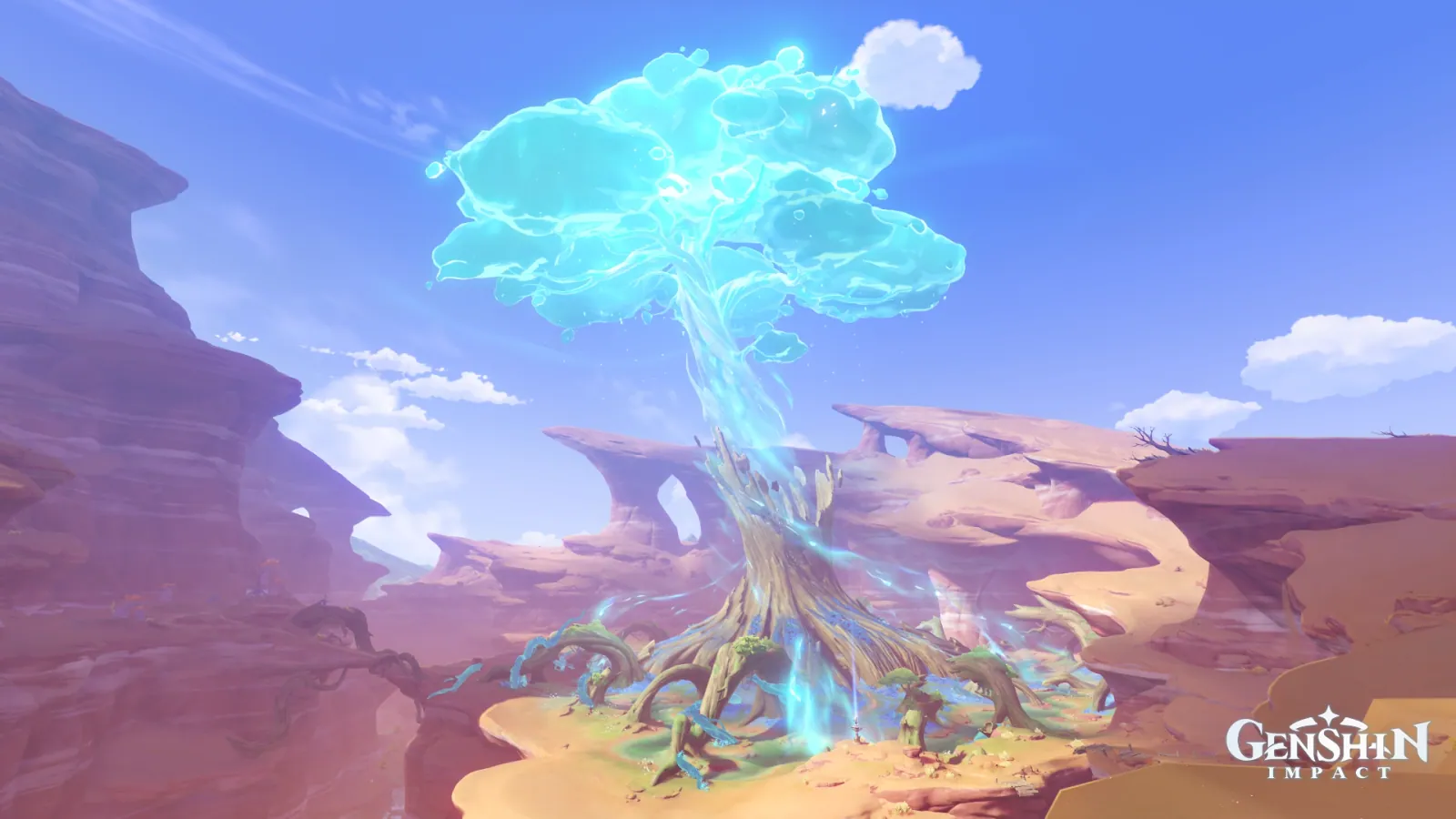
〈Wangshan Hall, Mossglow〉left a ruler: to be glowing is to cross the visible light source in the frame on both lightness and chroma (the moss pool at L 0.81 / chroma 0.093 against the skylight's 0.71 / 0.066). Carry that ruler outdoors and it snaps. Harvisptokhm's water tree measures L 0.89 / chroma 0.097 against the sky's 0.66 / 0.165 — one win, one loss — and nobody would say it is not glowing. The difference is that a sky is not a lamp but a surface covering 41.79%: all 4000 of the frame's most chromatic pixels lie inside the sky's 240°–270°. The chroma channel never belonged to anything on the ground. To build a glowing element outdoors, don't compete on saturation; open up the lightness gap, then give it a hue the environment cannot grow.

01

The tree's chroma is 0.006 above the median

The tree is made of water: its crown hangs in the air like an inverted cloud of it, a single stream falls from the crown's heart to the roots, and only under those roots is there a small oasis. Scoop up every pixel in the frame between 165° and 215° — essentially this tree — and you get 63203 of them, 6.86%, mean L 0.89 / chroma 0.097. The frame's median chroma is 0.091 and its p99 is 0.168: the tree is 0.006 more chromatic than half the picture and never reaches p99. Its lightness, meanwhile, stands 0.19 above the median of 0.70, and 2469 of the 4000 brightest pixels land on the crown (hue 195°–203°, L 0.96–0.97); most of the rest are the sun-bleached haze on the left (273°–276°, L 0.96, chroma 0.015). Everything this tree owns is staked on lightness.

02

The sky bought out the chroma ceiling

The sky at upper right (from 0.70, 0.00) measures L 0.66 / chroma 0.165 / hue 266°; take its most chromatic 3% and it is 0.169, and the frame's peak of 0.179 lies in that blue band too. 〈Quahuacan Cliff under Cumulus〉put it this way: the two ends of the palette live in the air, not on objects — the deep blue at the top of that frame is L 0.62 / chroma 0.158, the heart of the cloud L 0.98 / 0.015, one sky holding both extremes of lightness and chroma. Harvisptokhm hands over only one of them: the sky's lightness of 0.66 is below the frame's median of 0.70, so the bright end has been vacated, and that is the only place this tree could stand. Once a sky enters the frame it takes the chroma ranking automatically. What is left for the subject depends on what the sky gave up.

03

Dry air levies no tax on hue

Both canyon walls are the same red sandstone, ordered by distance from the sky: the left wall (from 0.00, 0.25) measures 295°, the right wall (from 0.82, 0.45) 322°, the near block (from 0.05, 0.60) 329°, and the sand floor 75° — the farthest is only 29° from the sky's 266°, the nearest sand 169° away. All eight hue bands are populated and the achromatic share is 1.97%. In the same batch, three Sumeru rainforests had wet air folding every surface into a stretch of 19°–65°; here the dry air barely folds anything, local colour stays where it is, and the gamut opens on its own. So read the air first: in a wet picture hue is levied by the atmosphere, and one unremade local colour is your focus; in a dry picture hue is already spent, and focus can only be found on lightness.

Take these colours with you

CSS variables, a Tailwind v4 theme or SVG — one click to copy into your project.

/* Harvisptokhm under a Dry Sky · Harvisptokhm under a Dry Sky — Teyvat Palette */
:root {
  --dry-sky: oklch(0.66 0.165 266); /* Dry Sky #628cf6 */
  --water-crown: oklch(0.89 0.097 204); /* Water Crown #87eef8 */
  --pale-trunk: oklch(0.72 0.049 317); /* Pale Trunk #b19cb9 */
  --haze-wall: oklch(0.61 0.095 295); /* Haze Wall #8777b6 */
  --sandstone-rose: oklch(0.65 0.076 322); /* Sandstone Rose #a580ab */
  --canyon-sand: oklch(0.8 0.077 75); /* Canyon Sand #dbb786 */
  --gradient-harvisptokhm: linear-gradient(180deg, oklch(0.66 0.165 266) 0%, oklch(0.89 0.097 204) 22%, oklch(0.61 0.095 295) 48%, oklch(0.65 0.076 322) 74%, oklch(0.8 0.077 75) 100%);
}

A 1080×1350 PNG carrying the scene, its palette and every value — save it and post it as is.