Teyvat PaletteTeyvat colour cards
Scene library
GitHub
Gallery
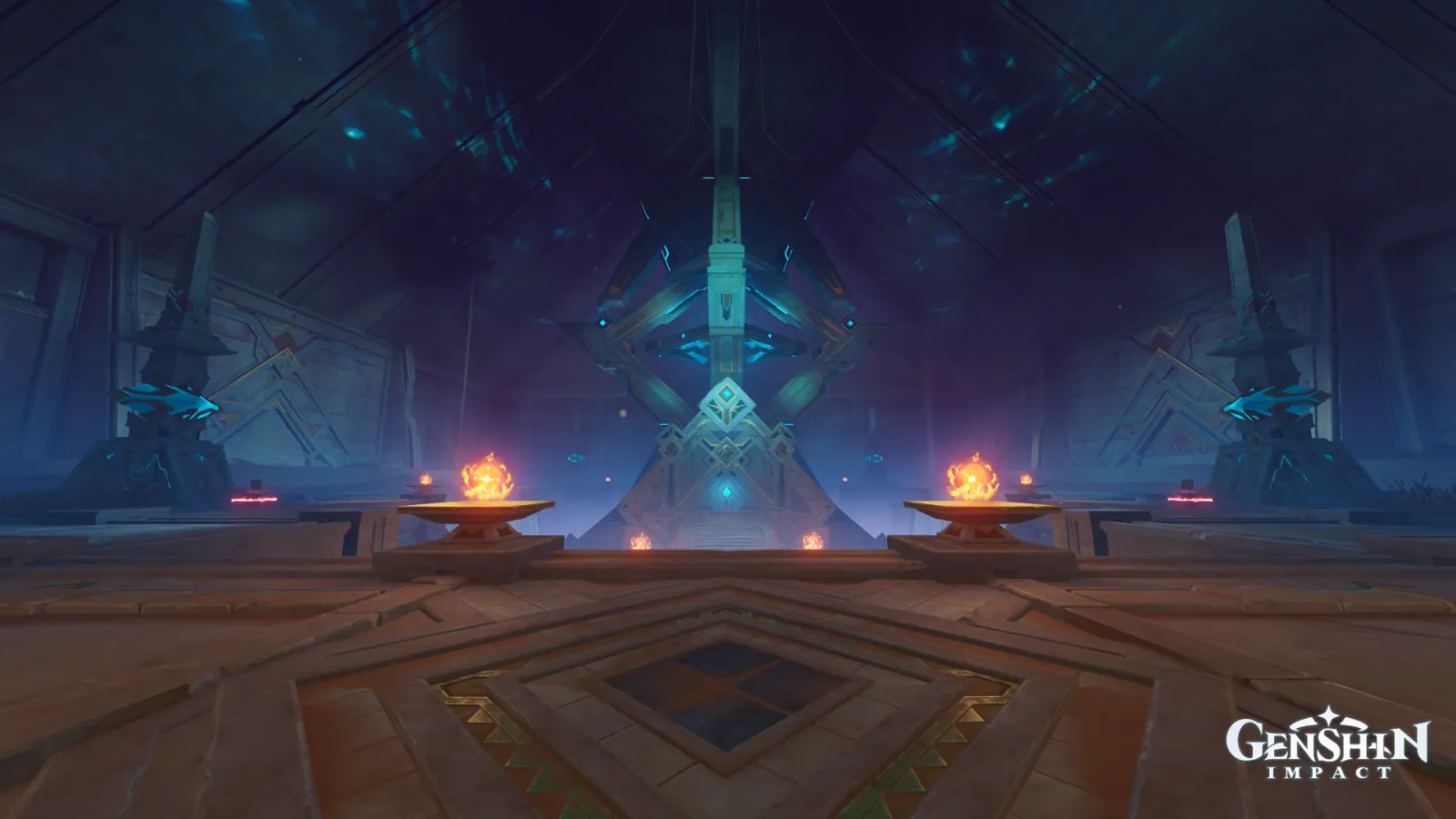
Great Hall of Truths by Brazier Light
SumeruSolemnCold-litKeeping vigil

Great Hall of Truths by Brazier Light

Palette

Click a swatch to copy its HEX; hover for the OKLCH value.

Reconstructed gradient

The gradient distilled from the scene, unrolled left to right by stop; the authored angle is 180° (used by the hero and exports), while gallery cards share a uniform 135° sweep.

0%181d3430%35416146%23cbd860%fcbd7170%be5f64100%4a352e

Why it works

With a coloured light, "further away" is billed to chroma, not to lightness — provided the floor already carries that light's hue. Measure the Great Hall's floor at four spots: directly under a brazier, chroma 0.036 / L 0.32; off to the side, 0.034 / 0.36; the bottom-left corner, 0.026 / 0.33; the far end of the central axis, 0.020 / 0.34. Lightness spans only 0.04 across the four, while chroma halves — and the furthest patch has already dropped below the achromatic threshold of 0.025. Schulz's Blacksmith by Forge Light measured lightness just as flat (all three spots within ΔL 0.05), but that floor was daylight cyan to begin with, so the difference had to be billed to hue (194° / 190° / 49°); here the floor is already the fire's warmth and hue has nothing to trade. When painting a floor under a lamp, first check whether the floor's own colour is the lamp's hue: if it is, move only chroma; if it isn't, move only hue. In neither case touch lightness.

01

Four spots on the floor, and only chroma moves

The terracotta paving along the bottom edge covers 28% of the frame — 221,875 pixels — averaging L 0.35 / chroma 0.032 / hue 38°. Measured spot by spot, the whole difference lands on chroma: 0.036 → 0.034 → 0.026 → 0.020, with hue drifting 22° toward yellow along the way (27° → 49°) and lightness never leaving 0.32–0.36. This is the cheapest kind of "distance" available in a dark scene: lightness is already spent on "this is a dark hall", and moving it again would read the floor as two storeys. To express distance from a light source across one flat colour of floor, lock lightness and let chroma fall; the patch that drops under the achromatic threshold marks the edge of that lamp's reach.

02

Whether a coloured light is a plane or a point decides whether grey survives

The two fires pay for the frame's ceiling themselves: the left bowl L 0.65 / chroma 0.096, the right L 0.64 / 0.099, with Cmax 0.162 and 0.164. Yet the floor they light, measured on the I-group's shared rectangle (0.30,0.85,0.30,0.12), is L 0.33 / chroma 0.024 / 41° — below the achromatic line. Adventurers' Guild Inazuma at Sunset reads 0.058 / 46° on the same rectangle: near-identical hue, 2.4 times the chroma, achromatic pushed down to 8.09%, while here achromatic is actually 9.37%. The I group's claim — that when the light itself has colour the largest surface stops being grey and the neutral budget goes to zero — depends on whether that light is a plane or a point. A whole sky at sunset covers everything; two braziers can only afford their own small patch.

03

The loudest family is 0.50% of the frame, and it isn't the fire

The band 165°–210° occupies only 0.50% of the frame, yet it carries the highest mean chroma of any band in the census (0.078, against violet 0.050 / blue 0.058 / orange 0.038), and its most saturated 3% — 132 pixels — sits at L 0.77 / chroma 0.126: the cyan glow on the central mechanism. Meanwhile, of the brightest 4000 pixels the left brazier holds 906 (L 0.84 / 0.118 / 70°) and the right holds 865 (L 0.84 / 0.122 / 69°), matching to four digits, while the central axis holds 466 at only L 0.76 / 0.090 / 200°. Two identical fires cancel each other's claim to "brightest", and the focus passes to the dimmer, smaller light that owns the only cyan in the picture. When more than one light is coloured, the focus goes to the one with the most exclusive hue, not the brightest one — and in a symmetrical composition especially: to name a focus, don't give the axis more light, give it a hue that exists nowhere else.

Take these colours with you

CSS variables, a Tailwind v4 theme or SVG — one click to copy into your project.

/* Great Hall of Truths by Brazier Light · Great Hall of Truths by Brazier Light — Teyvat Palette */
:root {
  --vault-violet: oklch(0.24 0.044 273); /* Vault Violet #181d34 */
  --hall-haze: oklch(0.38 0.057 267); /* Hall Haze #354161 */
  --mechanism-cyan: oklch(0.77 0.126 203); /* Mechanism Cyan #23cbd8 */
  --flame-core: oklch(0.84 0.118 70); /* Flame Core Gold #fcbd71 */
  --brazier-red: oklch(0.6 0.122 18); /* Brazier Red #be5f64 */
  --terracotta-floor: oklch(0.35 0.032 38); /* Terracotta Floor #4a352e */
  --gradient-great-hall-of-truths: linear-gradient(180deg, oklch(0.24 0.044 273) 0%, oklch(0.38 0.057 267) 30%, oklch(0.77 0.126 203) 46%, oklch(0.84 0.118 70) 60%, oklch(0.6 0.122 18) 70%, oklch(0.35 0.032 38) 100%);
}

A 1080×1350 PNG carrying the scene, its palette and every value — save it and post it as is.