Teyvat PaletteTeyvat colour cards
Scene library
GitHub
Gallery
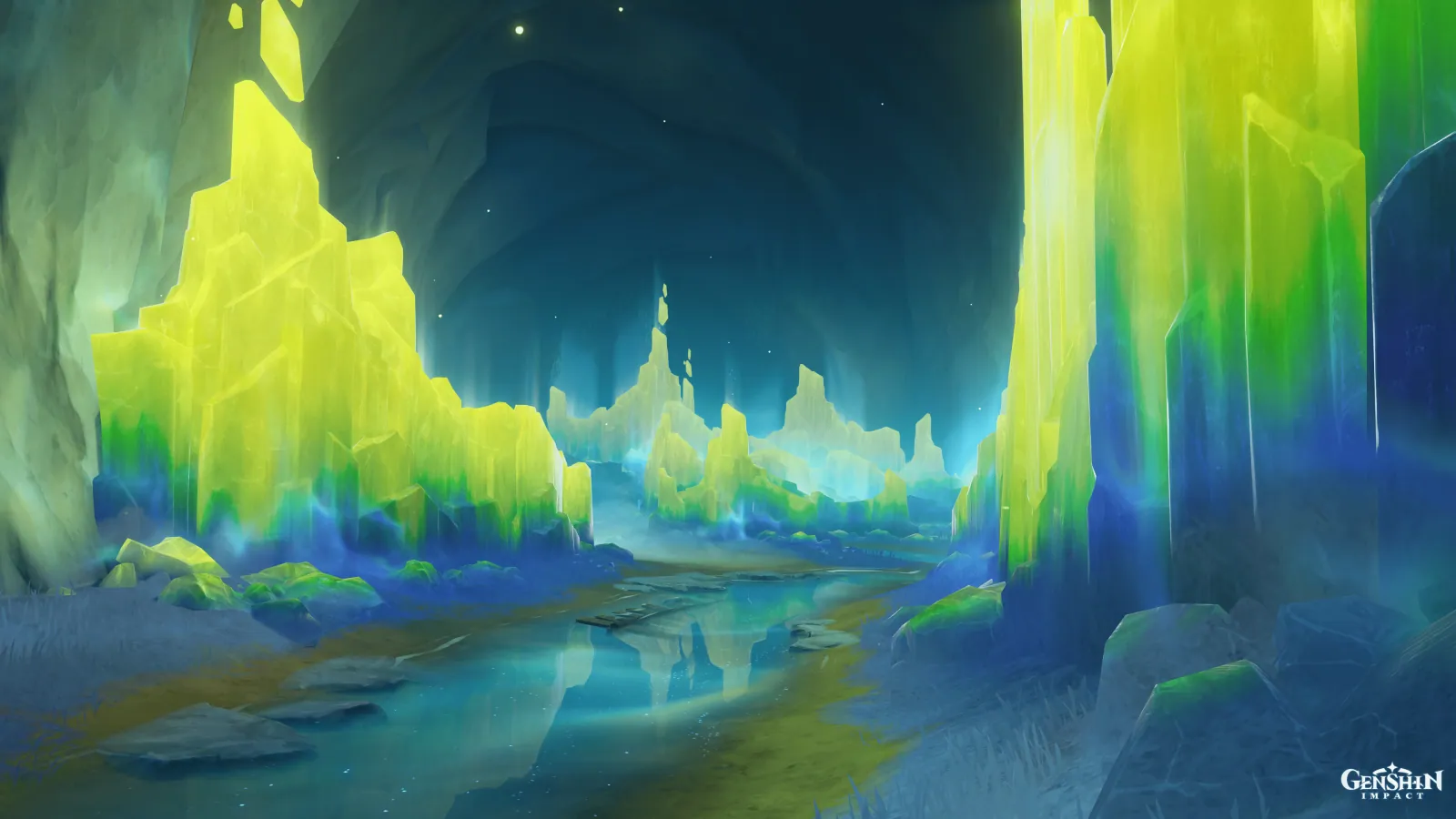
Geode Mine Shaft by Crystal Light
FontaineDeepCold-brightMineral

Geode Mine Shaft by Crystal Light

Palette

Click a swatch to copy its HEX; hover for the OKLCH value.

Reconstructed gradient

The gradient distilled from the scene, unrolled left to right by stop; the authored angle is 165° (used by the hero and exports), while gallery cards share a uniform 135° sweep.

0%e7f54f30%a0c76262%00a194100%133845

Why it works

The edge of something that emits its own light does not darken, it rotates in hue. Follow one crystal column from core to base and lightness falls from 0.93 to 0.63 while chroma barely moves (0.182 → 0.126) — what falls is hue, travelling 114° to 186°, straight toward the cavern wall's ambient 225°.

01

Fifty-nine degrees along a single column

Sample the same column on the right, high and low: the upper section reads L 0.78, chroma 0.137, hue 127°; the lower, L 0.63, chroma 0.126, hue 186°. Chroma gives up 0.011 while hue travels 59°, and the cavern wall's ambient sits at 225° — so the column is transitioning toward the ambient colour, not toward grey. That is how a light-emitting object is made to belong to its scene: let its dark end borrow the ambient's hue instead of simply being darkened. Darkening alone leaves it looking like a sticker pasted onto the picture.

02

The brightest place is also the most saturated

The brightest four thousand pixels average L 0.93 at chroma 0.182, spread across crystal cores at (0.18, 0.14), (0.73, 0.04) and (0.16, 0.33); the most saturated four thousand are the same pixels, at chroma 0.194, hue 141°. This is the exact reverse of the Hiisi Island study, where the brightest four thousand fall to chroma 0.020–0.031. The difference is what is being measured: Hiisi measured lit mist, and mist trades its chroma for brightness. Here we are measuring the source, and a source does not have to trade. Before deciding whether a highlight keeps its chroma, ask whether it is emitting or being lit.

03

Equal areas, double the chroma

Green covers 39.1% and blue 42.6% — an even split. But the green half averages chroma 0.128 against the blue half's 0.070, and their lightnesses stand 0.71 against 0.43. Achromatic pixels total 0.18% of the frame: nowhere in this cave is grey, not even the shadows. The pool on the floor measures L 0.58, chroma 0.075, hue 189°, landing between the column's base and the wall and handing the light down from the roof to the ground. There is no sky in the frame, so the time of day is left blank: the only light source in this picture is its own ore.

Take these colours with you

CSS variables, a Tailwind v4 theme or SVG — one click to copy into your project.

/* Geode Mine Shaft by Crystal Light · Geode Mine Shaft by Crystal Light — Teyvat Palette */
:root {
  --cavern-blue: oklch(0.32 0.048 225); /* Cavern Blue #133845 */
  --crystal-foot: oklch(0.63 0.126 186); /* Crystal Foot #00a194 */
  --crystal-body: oklch(0.78 0.137 127); /* Crystal Body #a0c762 */
  --crystal-core: oklch(0.93 0.182 114); /* Crystal Core #e7f54f */
  --still-water: oklch(0.58 0.075 189); /* Still Water #3d8983 */
  --gradient-geode-mine-shaft: linear-gradient(165deg, oklch(0.93 0.182 114) 0%, oklch(0.78 0.137 127) 30%, oklch(0.63 0.126 186) 62%, oklch(0.32 0.048 225) 100%);
}

A 1080×1350 PNG carrying the scene, its palette and every value — save it and post it as is.