Teyvat PaletteTeyvat colour cards
Scene library
GitHub
Gallery
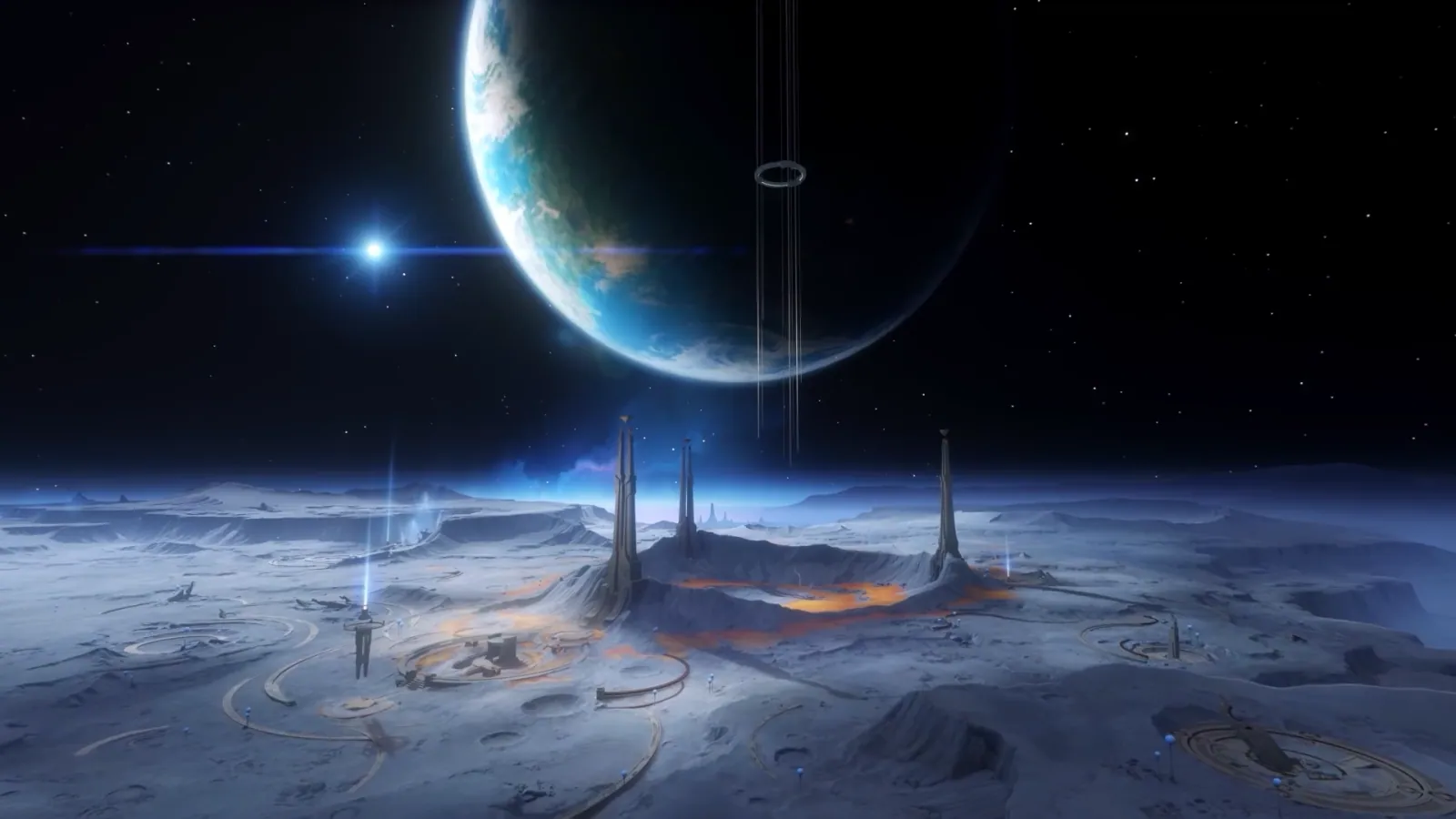
Frost Moon in Earthshine
Nod-KraiNightExtinctColdImmense

Frost Moon in Earthshine

Palette

Click a swatch to copy its HEX; hover for the OKLCH value.

Reconstructed gradient

The gradient distilled from the scene, unrolled left to right by stop; the authored angle is 180° (used by the hero and exports), while gallery cards share a uniform 135° sweep.

0%080d1758%20315782%646e8a100%475570

Why it works

Catching the eye is not the same as being saturated. The only warm thing in this picture covers 0.24% of the frame at chroma 0.063 — lower than the cold blue arc beside it (0.072). It becomes the focus because it is the one hue that does not belong to the blue family, in a field that is 35.2% achromatic and 56.5% blue.

01

A warm 0.24%, and not even the most saturated

The molten light in the fissures measures L 0.66, chroma 0.063, hue 47°, and the frame's orange and yellow bands together come to just 0.24%. The cold blue arc along the horizon measures L 0.32 at chroma 0.072 — a notch higher than the lava. So the focus was not built by piling on chroma; it is built by being the only case of its hue. To plant a focus in a cool picture you do not have to make it more vivid, only to make it the one hue outside the dominant family.

02

The surface hands its local colour over to the light

Lunar soil ought to be grey; it measures L 0.54, chroma 0.046, hue 270° — low chroma, yet the hue sits squarely in the blue-violet family, pointing the same way as the planet overhead and as the horizon arc. That is the evidence behind the title: what lights this surface arrives from above and is cold, not white. Toward the foreground the soil drops to L 0.45, and that ring of vignette keeps the eye penned in on the molten scars in the middle distance.

03

White goes to the rim, black to the sky

The brightest four thousand pixels average L 0.96 at chroma 0.020, all of them on the planet's lit rim around (0.33, 0.12) and (0.35, 0.29). The star field measures L 0.16 at chroma 0.022, with 35.2% of pixels below the grey threshold. Both extremes of the picture are achromatic, which leaves the 0.54 regolith between them as the only surface with any body — the extremes carry the range, the midtone carries the content.

Take these colours with you

CSS variables, a Tailwind v4 theme or SVG — one click to copy into your project.

/* Frost Moon in Earthshine · Frost Moon in Earthshine — Teyvat Palette */
:root {
  --void-black: oklch(0.16 0.022 264); /* Void Black #080d17 */
  --atmos-arc: oklch(0.32 0.072 264); /* Atmospheric Arc #203157 */
  --regolith-grey: oklch(0.54 0.046 270); /* Regolith Grey #646e8a */
  --molten-scar: oklch(0.66 0.063 47); /* Molten Scar #b38771 */
  --star-white: oklch(0.96 0.02 216); /* Star White #e4f6fa */
  --gradient-frost-moon: linear-gradient(180deg, oklch(0.16 0.022 264) 0%, oklch(0.32 0.072 264) 58%, oklch(0.54 0.046 270) 82%, oklch(0.45 0.048 263) 100%);
}

A 1080×1350 PNG carrying the scene, its palette and every value — save it and post it as is.