Teyvat PaletteTeyvat colour cards
Scene library
GitHub
Gallery
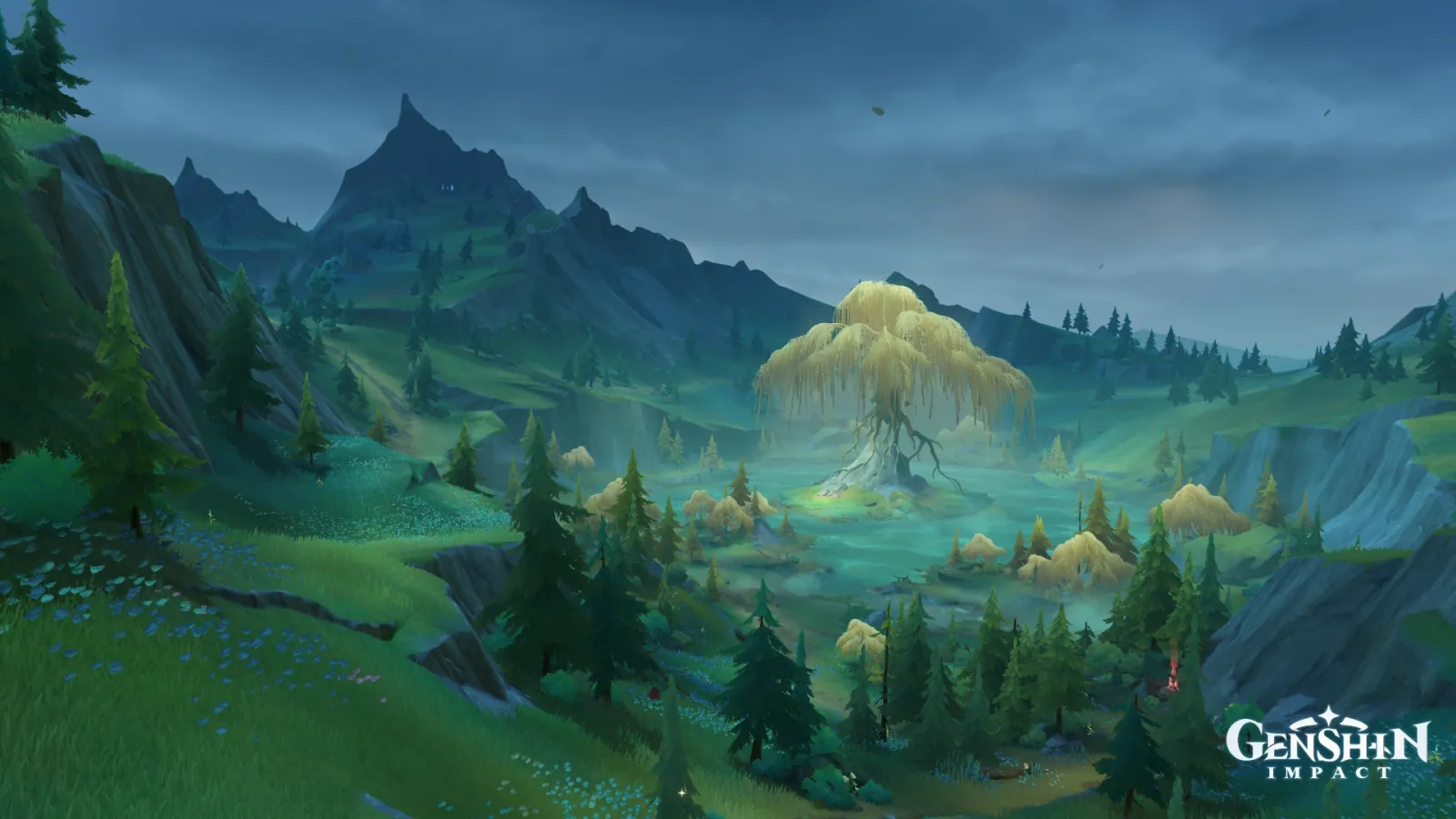
Erinnyes Forest at Blue Dusk
FontaineDuskhushedcold duskone lit thing

Erinnyes Forest at Blue Dusk

Palette

Click a swatch to copy its HEX; hover for the OKLCH value.

Reconstructed gradient

The gradient distilled from the scene, unrolled left to right by stop; the authored angle is 180° (used by the hero and exports), while gallery cards share a uniform 135° sweep.

0%3a688a20%28556e42%b3bf8256%91c48b76%4e8750100%1b5134

Why it works

A sky is allowed to hold no extreme at all: this one measures L 0.50, chroma 0.075 — just 0.03 above the frame's lightness median of 0.47 and 0.011 above its chroma median of 0.064, reaching neither end. So 2679 of the brightest 4000 pixels land on the weeping willow at the heart of the basin, and 3978 of the most chromatic ones land on the near woodland. Once the sky steps aside, anything in the picture can climb onto the lightness ceiling and become the light — and once it is the light, its hue stops being worth discussing. The tree everyone reads as golden measures 117°.

01

The sky took nothing

The strip of sky across the top centre (x 0.30–0.70, y 0.02–0.14) measures L 0.50 / chroma 0.075 / 242°; the strip at top left is L 0.48 / 0.073 / 236°. The frame's lightness median is 0.47, its chroma median 0.064, its chroma p99 0.091. The brightest 4000 pixels fall into four cells — centred at (0.63, 0.37), (0.58, 0.51), (0.59, 0.37) and (0.63, 0.41), 2679 in total — all of them on that willow. Of the most chromatic 4000, 3978 sit in 120°–180°, centred at (0.38, 0.67) and (0.41, 0.66): the woodland slope left of centre. Harvisptokhm under a Dry Sky is the flat counter-example — there the clear sky is both the light source and the most chromatic surface in the frame, with the most chromatic 4000 pixels going 4000/4000 to the sky. Hang the same object in the same place; whether or not those two extremes are taken decides who owns the light.

02

The willow trades chroma for lightness

The most chromatic 3% of the rectangle around the willow's crown (580 pixels) measures L 0.78 / chroma 0.082 / 117°, while the near woodland's green is L 0.57 / chroma 0.103 / 145°. The willow is 0.21 brighter than the woodland and 0.021 paler — it spends lightness only, and this picture happens to have left its lightness budget untouched: the frame's L p99 is only 0.69, and the mean of those 580 crown pixels clears that line by another 0.09. To make something read as the light, don't reach for saturation first — look at how much lightness your picture still has left unspent.

03

The gold is 117°, and the warm pixels number 88

Search the whole frame for warmth in 330°–90° and 88 pixels match — 0.010% of the picture, mean chroma 0.052. In 45°–90°, real yellow, only 14 remain, chroma 0.030, barely over the achromatic line. That patch of cloud at the top right that looks like afterglow measures L 0.59 / chroma 0.052 / 238°, and a 330°–90° search inside the same rectangle returns nothing matched. Elton Trench in Dim Daylight measured the same illusion, but there the three things read as gold were the most chromatic in the frame (chroma 0.194 and 0.161) — what worked was the hue's rank inside the picture. Here the willow's chroma is 0.082, below the 0.103 of the woodland beside it. Building a golden focus needs no move on the colour wheel and none on saturation: clearing the lightness ceiling and handing it over is enough.

Take these colours with you

CSS variables, a Tailwind v4 theme or SVG — one click to copy into your project.

/* Erinnyes Forest at Blue Dusk · Erinnyes Forest at Blue Dusk — Teyvat Palette */
:root {
  --dusk-overcast: oklch(0.5 0.075 242); /* Dusk Overcast #3a688a */
  --willow-gold: oklch(0.78 0.082 117); /* Willow Gold #b3bf82 */
  --basin-mist: oklch(0.77 0.096 142); /* Basin Mist #91c48b */
  --near-woods: oklch(0.57 0.103 145); /* Near Woods #4e8750 */
  --ridge-blue: oklch(0.43 0.064 234); /* Ridge Blue #28556e */
  --slope-shadow: oklch(0.39 0.075 157); /* Slope Shadow #1b5134 */
  --gradient-erinnyes-forest: linear-gradient(180deg, oklch(0.5 0.075 242) 0%, oklch(0.43 0.064 234) 20%, oklch(0.78 0.082 117) 42%, oklch(0.77 0.096 142) 56%, oklch(0.57 0.103 145) 76%, oklch(0.39 0.075 157) 100%);
}

A 1080×1350 PNG carrying the scene, its palette and every value — save it and post it as is.