Teyvat PaletteTeyvat colour cards
Scene library
GitHub
Gallery
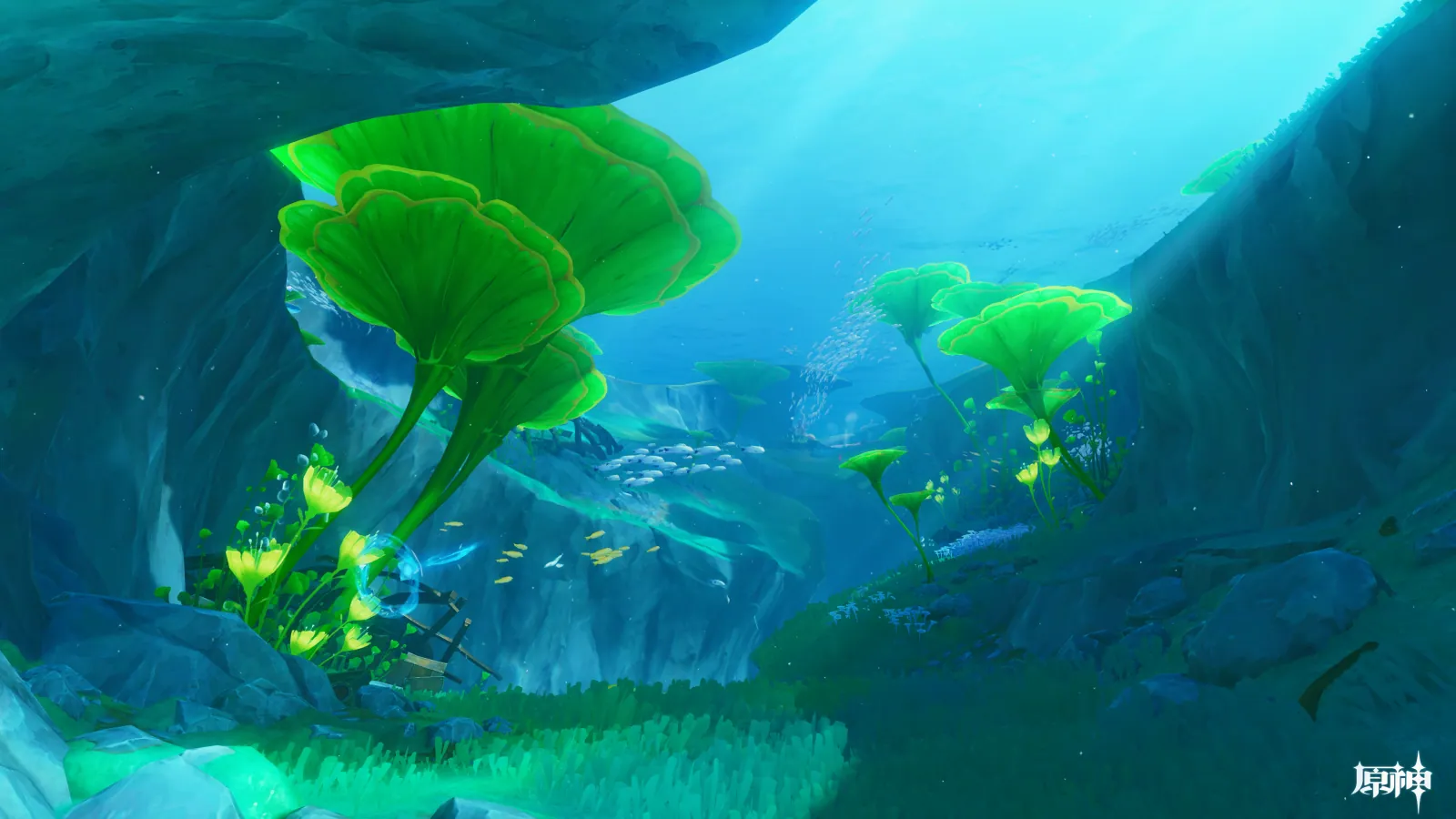
Elton Trench in Dimmed Daylight
FontaineDayAbyssalVerdantHushed

Elton Trench in Dimmed Daylight

Palette

Click a swatch to copy its HEX; hover for the OKLCH value.

Reconstructed gradient

The gradient distilled from the scene, unrolled left to right by stop; the authored angle is 180° (used by the hero and exports), while gallery cards share a uniform 135° sweep.

0%62e7f726%20929358%096b8582%0fa530100%1ae044

Why it works

Warm is a rank inside the frame, not a position on the wheel: search the whole picture between 330° and 90° and not one pixel matches, and 90°–110° is empty too — yet the gold rim on the leaves, the yellow flowers at lower left and the small fish mid-frame all read as warm. They measure 145°, 145° and 142°: yellow-green. Against a field of 223° blue that owns 54.58%, whichever hue family sits nearest the warm end is taken for gold.

01

Half the wheel goes entirely unused

Search the frame between 330° and 90° and nothing matches; 45°–90°, nothing; 90°–110°, still nothing. Only at 90°–120° do 133 pixels appear, 0.015% of the frame. Green 14.17% plus cyan 31.26% plus blue 54.58% is the whole picture. And 123 of those 133 pixels sit in the heart of the flower cluster at lower left — hue 119°, L 0.89: the warmest thing this picture can produce, and it is still green. Qiongji Estuary made the same argument on the lightness axis — in a high-key frame 'black' is relative, and what you need is not black but a plane 0.2 below its neighbours. The rule on the hue axis is identical.

02

Three 'warm' things, all yellow-green

The gold rim on the big fan kelp at upper left, counting only its green-band pixels, measures 145°, chroma 0.194, L 0.63. The yellow flowers at lower left carry 15,181 green-band pixels at 145°, chroma 0.161, L 0.61. The small fish mid-frame are the weakest of the three: the most chromatic 3% of the rect around them is not fish at all but 217° water, and the fish themselves come to 519 pixels at 142°, chroma 0.102, L 0.72. Under 4° separates the three, and the kelp behind them (145°, chroma 0.243) is the same family. What makes them read as gold rim, yellow bloom and amber fish is entirely the division of lightness and chroma; the hue never moves a step.

03

The same green is scenery elsewhere and gold here

Salacia Plain's water plants measure 145°, chroma 0.174, at 35.96% of the frame, and read as vegetation. This green is 148°, chroma 0.167 — very nearly the same colour — but it holds only 14.17%, with 54.58% of 223° blue pressing in behind it. Salacia also still keeps 749 genuinely yellow pixels (45°–90°, mean 81°); this frame has none at all. The colour did not change; its rank inside the frame did. To place a 'warm' accent in a single-toned picture, measure the hue of your field first, then move towards the warm end only until nothing else is closer — you never have to enter the warm region, and what you save is half the wheel.

Take these colours with you

CSS variables, a Tailwind v4 theme or SVG — one click to copy into your project.

/* Elton Trench in Dimmed Daylight · Elton Trench in Dimmed Daylight — Teyvat Palette */
:root {
  --trench-blue: oklch(0.49 0.089 223); /* Trench Blue #096b85 */
  --midwater-teal: oklch(0.6 0.095 196); /* Midwater Teal #209293 */
  --daylight-cyan: oklch(0.86 0.117 206); /* Daylight Cyan #62e7f7 */
  --fan-kelp: oklch(0.79 0.243 145); /* Fan-Kelp Green #1ae044 */
  --leaf-rim-gold: oklch(0.63 0.194 145); /* Leaf-Rim Gold #0fa530 */
  --minnow-amber: oklch(0.72 0.102 142); /* Minnow Amber #7fb579 */
  --gradient-elton-trench: linear-gradient(180deg, oklch(0.86 0.117 206) 0%, oklch(0.6 0.095 196) 26%, oklch(0.49 0.089 223) 58%, oklch(0.63 0.194 145) 82%, oklch(0.79 0.243 145) 100%);
}

A 1080×1350 PNG carrying the scene, its palette and every value — save it and post it as is.