Teyvat PaletteTeyvat colour cards
Scene library
GitHub
Gallery
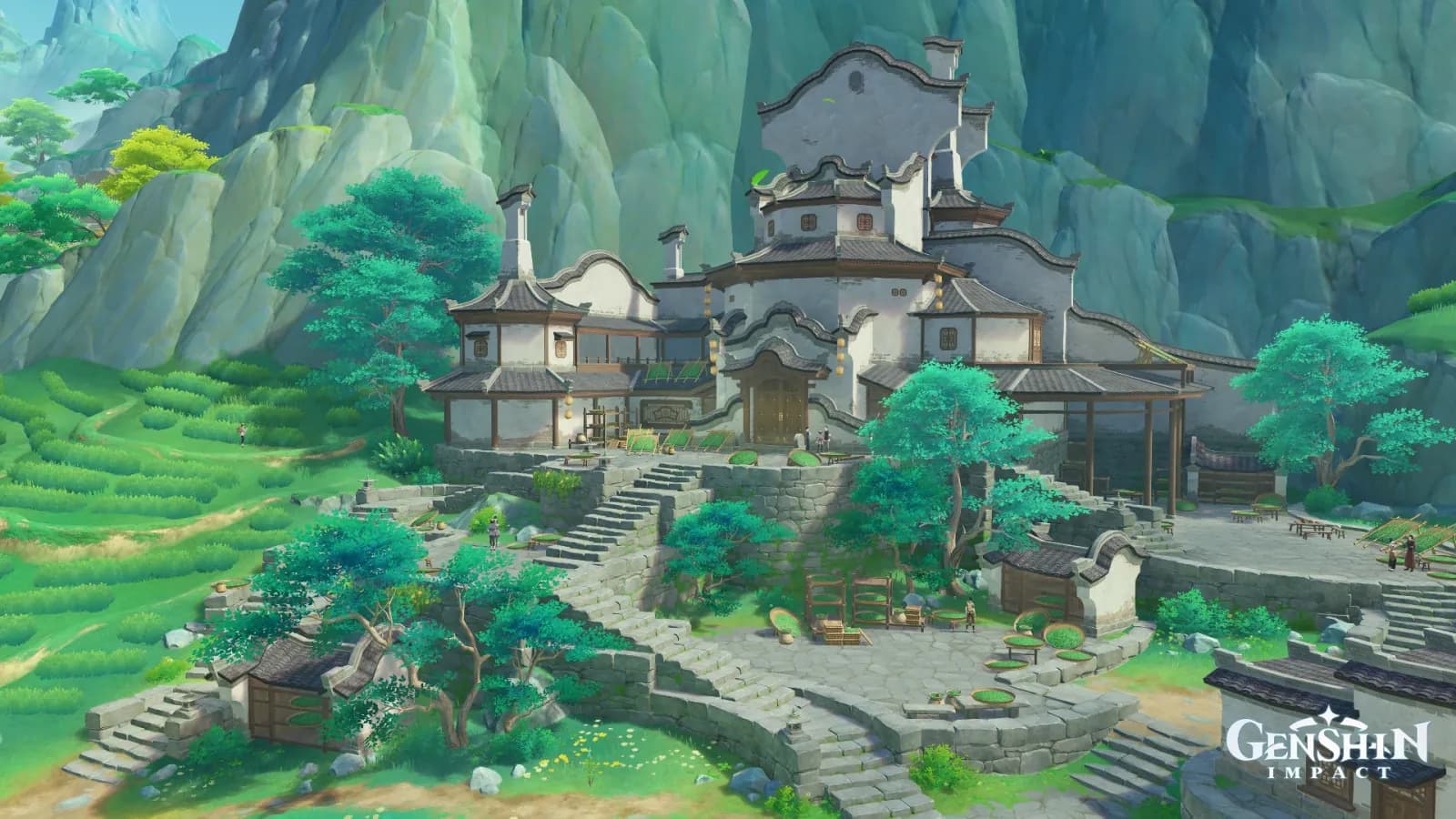
Chunming Teaworks in Verdant Daylight
LiyueDayClear and MoistLushMountain Living

Chunming Teaworks in Verdant Daylight

Palette

Click a swatch to copy its HEX; hover for the OKLCH value.

Reconstructed gradient

The gradient distilled from the scene, unrolled left to right by stop; the authored angle is 190° (used by the hero and exports), while gallery cards share a uniform 135° sweep.

0%376e6f18%4f6c7338%378e7e58%dfe4d476%608872100%62ad5f

Why it works

Whether area gets to decide the dominant colour has a threshold, and it is a ratio: 150°–180° holds 282,997 pixels here, 89% more than the 149,431 in 120°–150°. Yet of the 4000 most chromatic pixels the first band takes only 353 and the second 3,487 — that extra four fifths of area bought no votes at all. In 〈Lisha in Golden Daylight〉 a 4.6× area held down the top-end volume; the 1.89× here does not. When you audit a palette, do not let area name the dominant colour unless it leads by more than double.

01

Area returns a dead heat here

The green of 90°–165° holds 314,656 pixels and the teal of 165°–210° holds 314,576 — 80 pixels apart, 35.74% against 35.73%. That is a whole hillside of tea terraces against a whole hillside of canopy and cliff. The third candidate dropped out long ago: the teahouse's own plaster is the bulk of that 17.14% achromatic share, and the 4000 brightest pixels measure L 0.91 / chroma 0.021. Meanwhile 330°–30° across the entire frame holds 42 pixels — a Liyue teahouse without a single note of vermilion. The dominant colour can only be the green or the teal, and counting area dead-ends right here; recount in 30° bins and the mode still sits on the teal side.

02

Four fifths more, and no hue to show for it

Of the 4000 most chromatic pixels, 120°–150° takes 3,487 and 150°–180° takes 353 — 9.9×, running exactly counter to area. Those 3,487 have a mean position of (0.20, 0.50), the tea terraces spilling down the slope on the left: the rectangle from (0.02, 0.55), 0.15 wide and 0.12 tall, measures L 0.68 / chroma 0.134 / 143°, and its most chromatic 3% reaches 0.161. The teal family has no surface lit like that — the big tree in front at (0.24, 0.20) reads L 0.59 / 0.087 / 179°, and the cliff across the valley at (0.86, 0.20) reads L 0.50 / 0.058 / 198°. Hence the two ceilings: 0.216 against 0.157.

03

Area only counts past a ratio

In 〈Lisha in Golden Daylight〉 the blue band held 529,098 pixels against the green band's 115,260, and that 4.6× of area held down the opposite sign in the top end — green 3,244 of the most chromatic 4000, blue 573 — so the dominant colour stayed blue. This picture drops the ratio to 1.89 and it no longer holds. So "which family is largest" and "whose cluster against the ceiling is thickest" must not only be reported separately, you also have to ask by how much the first one leads: a lead under double is the size of the background, not a claim on the dominant colour. Same in interface work — to make a colour dominant you need not flood the largest surface, only make it one step thicker than its neighbours where the light falls.

Take these colours with you

CSS variables, a Tailwind v4 theme or SVG — one click to copy into your project.

/* Chunming Teaworks in Verdant Daylight · Chunming Teaworks in Verdant Daylight — Teyvat Palette */
:root {
  --tea-terrace-green: oklch(0.68 0.134 143); /* Tea-Terrace Green #62ad5f */
  --canopy-teal: oklch(0.59 0.087 179); /* Canopy Teal #378e7e */
  --far-cliff-slate: oklch(0.5 0.058 198); /* Far-Cliff Slate #376e6f */
  --stone-step: oklch(0.59 0.056 160); /* Stone Step #608872 */
  --roof-slate: oklch(0.51 0.036 216); /* Roof Slate #4f6c73 */
  --plaster-white: oklch(0.91 0.021 119); /* Plaster White #dfe4d4 */
  --gradient-chunming-teaworks: linear-gradient(190deg, oklch(0.5 0.058 198) 0%, oklch(0.51 0.036 216) 18%, oklch(0.59 0.087 179) 38%, oklch(0.91 0.021 119) 58%, oklch(0.59 0.056 160) 76%, oklch(0.68 0.134 143) 100%);
}

A 1080×1350 PNG carrying the scene, its palette and every value — save it and post it as is.