Teyvat PaletteTeyvat colour cards
Scene library
GitHub
Gallery
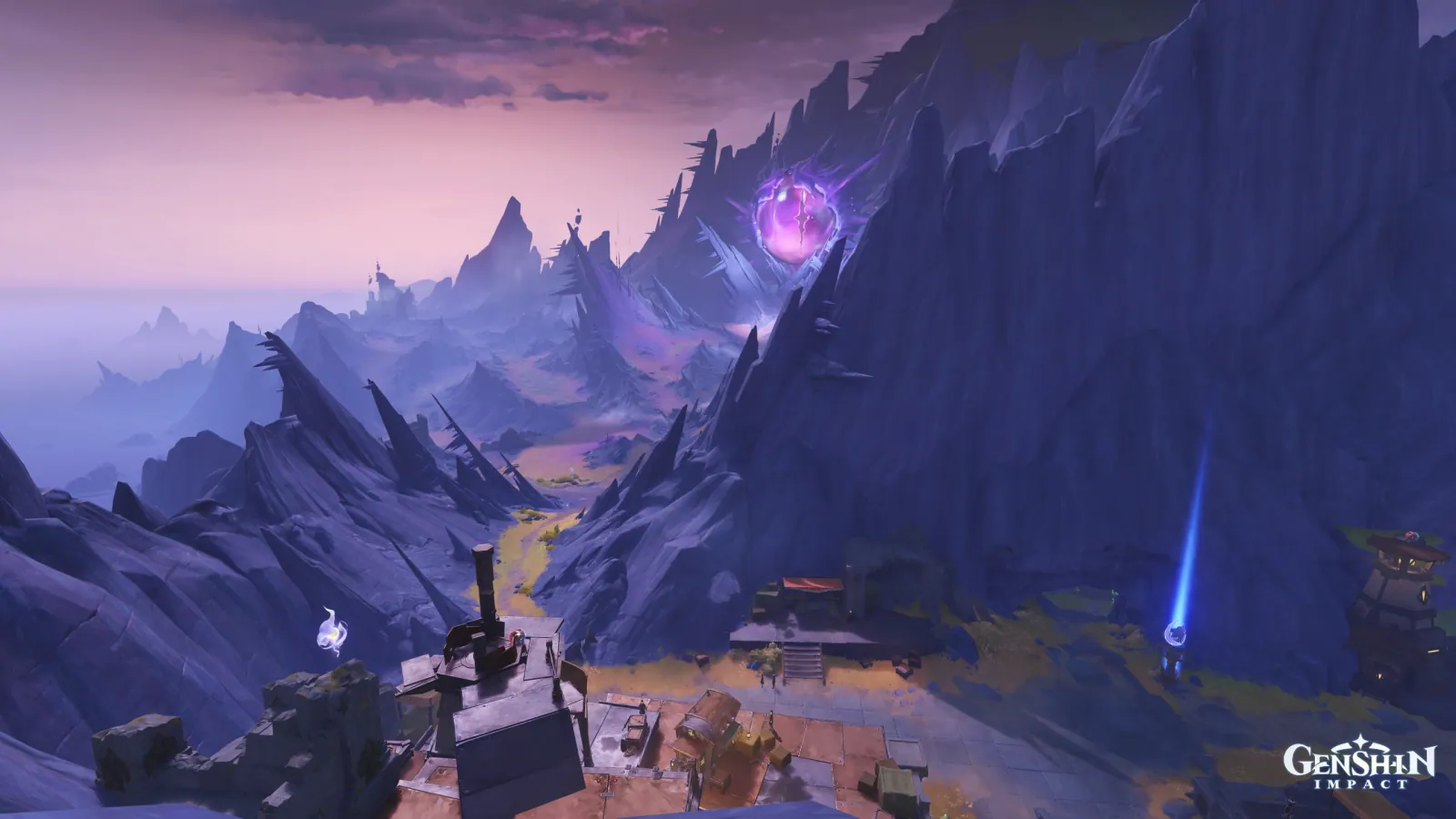
Ashveil Peak in Evening Haze
Nod-KraiDuskHushedBleakOminous

Ashveil Peak in Evening Haze

Palette

Click a swatch to copy its HEX; hover for the OKLCH value.

Reconstructed gradient

The gradient distilled from the scene, unrolled left to right by stop; the authored angle is 180° (used by the hero and exports), while gallery cards share a uniform 135° sweep.

0%6a568028%bfa1ce62%655382100%2b2f61

Why it works

The same measurement, the opposite result: on Hiisi Island the brightest 4000 pixels all sat on the light sources (L 0.96, chroma 0.020–0.031); here 3817 of them land in a patch of empty mist on the left (L 0.87, chroma 0.049) — while the two things actually emitting, the violet core in the rock at L 0.66 and the blue shaft under the cliff at L 0.48, carry chroma 0.209 and 0.210. When the ground itself already has colour, glowing can only be said in chroma.

01

The brightest patch holds nothing

3817 of the frame's brightest 4000 pixels crowd at (0.28, 0.30) — the empty haze above the far peaks on the left, averaging L 0.87 at chroma 0.049, below the frame's median chroma of 0.084. That low band pinned to the horizon is also the only direction light comes from, and it is the sole basis for calling the hour dusk. Everything else is small change: 113 pixels of a white wisp drifting over the slope (L 0.91, chroma 0.033), 56 more on the rim of the violet core. The eye does not award "brightest" to the light source. It awards it to the furthest thing first.

02

Two light sources share one chroma

The violet core wedged into a fissure, shards blown out around it, measures L 0.66, chroma 0.209, hue 313°. The blue shaft dropping vertically from the cliff onto the camp terrace measures L 0.48, chroma 0.210, hue 269°. They differ by 0.18 in lightness and 44° in hue, and by 0.001 in chroma — and the shaft's hue band, 210°–270°, is only 0.34% of the frame, so not even its hue was handed to it by the surroundings. The violet environment they stand in averages chroma 0.085: the sources are 2.5 times more chromatic than their surroundings while sitting just 0.10 above the frame's median lightness of 0.38. The property they share is the one that says "this emits".

03

Lightness is already leased to the air

The haze band on the left measures L 0.75 at chroma 0.071; the near cliff on the right, L 0.33 at chroma 0.087 — the whole 0.42 of lightness is spent saying depth, while chroma barely moves between the two ends. And achromatic pixels come to just 1.69%, so there is not even a sheet of grey to give up. With no balance left in lightness or in neutral area, emphasis has one road: chroma. That is also how glow is priced. Cavern Glow, the cave inside this same mountain, has a median chroma of 0.034, so its emitters need only reach 0.178 to dazzle; here the ground is already at 0.084, and a light source has to climb to 0.209 before it can speak. The same holds in a dark interface: once the background is a gradient or a photograph, stop signalling emphasis with "brighter" — give it chroma, and keep lightness for depth.

Take these colours with you

CSS variables, a Tailwind v4 theme or SVG — one click to copy into your project.

/* Ashveil Peak in Evening Haze · Ashveil Peak in Evening Haze — Teyvat Palette */
:root {
  --dusk-haze: oklch(0.75 0.071 314); /* Dusk Haze #bfa1ce */
  --cloud-crown: oklch(0.49 0.07 306); /* Cloud Crown #6a5680 */
  --scarp-violet: oklch(0.33 0.087 277); /* Scarp Violet #2b2f61 */
  --abyss-core: oklch(0.66 0.209 313); /* Abyss Core #be62eb */
  --beacon-blue: oklch(0.48 0.21 269); /* Beacon Blue #3149d1 */
  --camp-ochre: oklch(0.6 0.053 41); /* Camp Ochre #9c7668 */
  --gradient-ashveil-peak: linear-gradient(180deg, oklch(0.49 0.07 306) 0%, oklch(0.75 0.071 314) 28%, oklch(0.48 0.077 301) 62%, oklch(0.33 0.087 277) 100%);
}

A 1080×1350 PNG carrying the scene, its palette and every value — save it and post it as is.