Teyvat PaletteTeyvat colour cards
Scene library
GitHub
Gallery
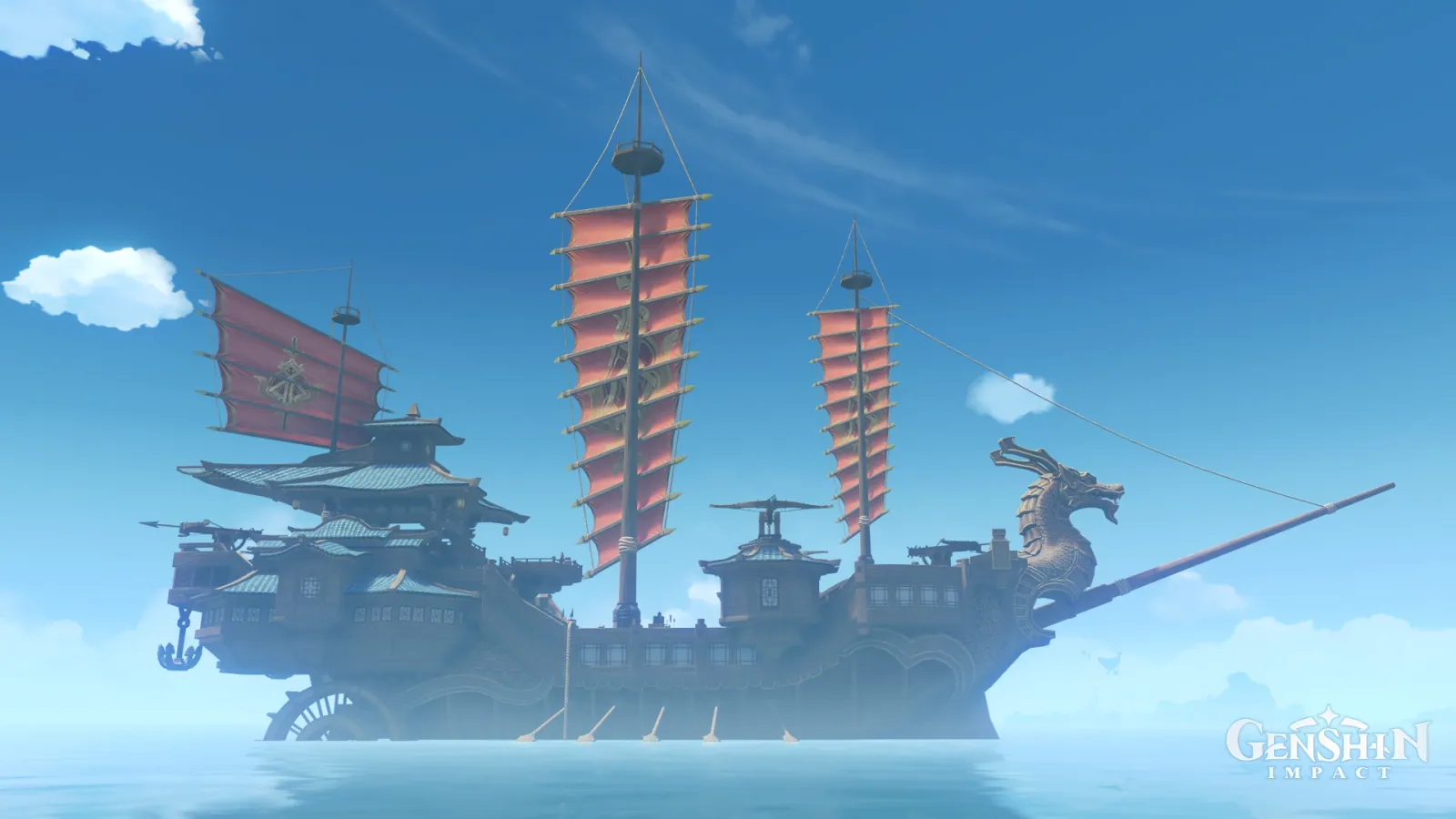
Alcor in Thin Haze
LiyueDayVastLimpidAdrift

Alcor in Thin Haze

Palette

Click a swatch to copy its HEX; hover for the OKLCH value.

Reconstructed gradient

The gradient distilled from the scene, unrolled left to right by stop; the authored angle is 180° (used by the hero and exports), while gallery cards share a uniform 135° sweep.

0%3879b142%539ece58%def7fd80%6995b5100%75b1cd

Why it works

Air does not wash colour out; it pushes colour around the wheel toward the sky's family, and only along the shorter arc. The hull rectangle of a wooden ship cannot produce a single warm pixel (`330°–90°` returns nothing matched), the dragon head has 3 left, and 92.5% of the ship's pixels sit on the sky's 238°. Only the sails survived — and they drag a 17,024-pixel band of pink and violet behind them, while the road on the other side of the wheel, twice as wide, holds just 2,278.

01

A wooden ship with no warm pixel

The ship rectangle — starting at (0.10, 0.50), 0.60 wide and 0.35 tall — holds 193,536 pixels, mean hue 241°, chroma 0.068. Of those, 179,057 (92.5%) fall in 210°–270° and average 238°, against 239° for the sky on the right: one degree apart. Object by object it is harsher still. The `330°–90°` window over the hull rectangle returns nothing matched; the dragon head has 3 warm pixels; even those glazed roofs keep only 39 pixels inside 150°–215°, the whole roof now averaging 236° at chroma 0.063. And the frame is only 2.02% achromatic: the haze did not push one pixel toward grey. It married the materials off to the sky instead.

02

17,024 on the short road, 2,278 on the long one

The sails sit at 11°, the sky at 239°, and the wheel offers two roads: the short arc through 330° and 294°, 132° of it, and the long arc through 45° and 150°, 228°. On the short one (`270°–345°`, 75° wide) there are 17,024 pixels averaging 312° at chroma 0.037 — more than the 16,831 in the frame's entire warm window. The window on the long arc (`60°–210°`) is 150° wide, twice as much room, and holds 2,278. The intermediate hues that appear in a hazy picture were never painted; they are the road itself. To predict which mid-tones a foggy scene will grow, measure the short arc from the object's hue to the sky's — the other half of the wheel stays empty.

03

One bolt of canvas, two doses

The main sail, from (0.378, 0.255), holds 10,887 pixels in the warm window at hue 13° and chroma 0.062, with a pink-violet fringe of 5,172. Measure the aft sail on the left the same way and only 740 warm pixels remain — already retreated to 333° — against a fringe of 7,974. Same cloth, same pigment; the only difference is how much haze lies in front, and the ratio flips from 2.1 : 1 to 1 : 10.8. 〈Starfell Valley in Clear Air〉 said a distance may hand an object's local colour over to the air in full; Alcor breaks that payment into instalments and photographs the middle of it. Gradients work the same way: do not retune a distant object straight to the fog colour — walk it along the short arc and the mid-steps you needed will grow on their own.

Take these colours with you

CSS variables, a Tailwind v4 theme or SVG — one click to copy into your project.

/* Alcor in Thin Haze · Alcor in Thin Haze — Teyvat Palette */
:root {
  --zenith-blue: oklch(0.56 0.109 247); /* Zenith Blue #3879b1 */
  --sea-haze: oklch(0.96 0.027 213); /* Sea Haze #def7fd */
  --hull-blue: oklch(0.65 0.068 241); /* Hull Blue #6995b5 */
  --crossing-violet: oklch(0.53 0.037 312); /* Crossing Violet #73667c */
  --ember-vermilion: oklch(0.63 0.06 11); /* Ember Vermilion #aa7a80 */
  --gradient-alcor: linear-gradient(180deg, oklch(0.56 0.109 247) 0%, oklch(0.67 0.103 239) 42%, oklch(0.96 0.027 213) 58%, oklch(0.65 0.068 241) 80%, oklch(0.73 0.074 229) 100%);
}

A 1080×1350 PNG carrying the scene, its palette and every value — save it and post it as is.